English
 Español
 tiếng việt
 русский
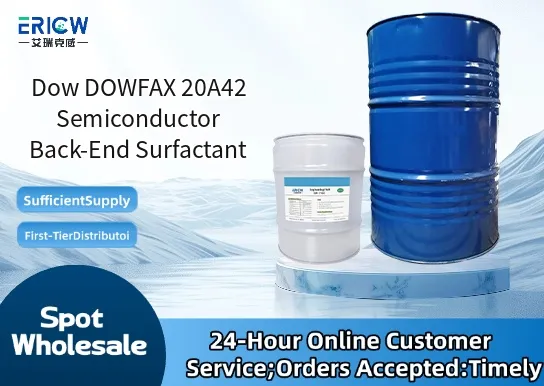
Ultra-low ionic residue profile optimized for semiconductor back-end-of-line (BEOL) cleaning processes.
Highly effective in removing post-etch and post-CMP organic residues without attacking low-k dielectrics or metal interconnects.
Excellent aqueous solubility and stable performance across a wide pH range (pH 4–10).
Low foaming formulation designed for compatibility with megasonic and spray rinse tools.
Controlled molecular weight distribution ensures consistent surface activity and minimal extractables.
Residue removal after copper or cobalt etch processes in advanced logic and memory devices.
Post-chemical mechanical polishing (post-CMP) cleaning of Cu/low-k interconnect structures.
Final rinse additive in wafer-level packaging (WLP) and fan-out processes.
Surface conditioning prior to dielectric capping or barrier layer deposition.
Enabling particle-free drying in immersion spin-rinse-dry (SRD) systems.
| Chemical Type | Alkyl ether sulfate (AES) – branched, low-sulfate, high-purity anionic surfactant |
| Product Form | Aqueous solution (~30% active) |
| Appearance | Clear, colorless to pale yellow liquid |
| pH (1% aqueous solution, 25°C) | 6.0 – 7.5 |
| Primary Applications | BEOL cleaning, post-etch/post-CMP residue removal, low-k compatible rinse aid |
| Key Features | Ultra-low sodium, chloride, sulfate, and heavy metal content; SEMI S2/S8 compliant manufacturing |
| Benefits | Reduces pattern collapse risk; minimizes metal corrosion and dielectric leaching; supports <22 nm node yield |
| Regulatory Compliance | REACH registered; RoHS 2 compliant; no SVHCs above threshold per current candidate list |
| Common Compatible Systems | Suitability |
| Megasonic immersion tanks (e.g., Modutek, Shibaura) | Highly Recommended – Proven stability under 950 kHz ultrasonic energy with no degradation or foam carryover |
| Spray rinse modules (e.g., Tokyo Electron, Lam Research) | Highly Recommended – Low-viscosity formulation enables uniform nozzle delivery and rapid drainage |
| Spin-rinse-dry (SRD) platforms | Recommended – Compatible with standard PTFE/NBR seals and stainless-steel wetted parts |
| DI water-based dilution systems with inline conductivity monitoring | Suitable – Non-interfering with TOC and conductivity sensors at typical use concentrations (50–200 ppm) |
Q1: What is the CAS Registry Number for DOWFAX 20A42?
A: The CAS number is 68439-49-6 (representing the purified AES fraction used in this grade; full composition includes proprietary stabilizers).
Q2: What is the recommended usage concentration in BEOL cleaning formulations?
A: Typical working concentration ranges from 50 ppm to 200 ppm in deionized water; optimal dosage is determined by residue type, tool configuration, and rinse time—validation via blanket wafer testing is advised.
Q3: How does DOWFAX 20A42 compare to DOWFAX C10-6 in semiconductor applications?
A: Unlike C10-6 (a general-purpose linear AES), 20A42 features tighter molecular weight control, lower sulfate counterions, and enhanced purification to meet semiconductor-grade metal and particle specs—making it suitable for <10 nm BEOL where C10-6 is not qualified.
Q4: Is DOWFAX 20A42 certified for use in ISO Class 1 cleanrooms and SEMI F57-compliant processes?
A: Yes—manufactured in an ISO Class 1-certified facility; meets SEMI F57 requirements for metallic impurities (<10 ppt Na, K, Fe, Ni, Cu) and non-volatile residue (<1 µg/cm² at 1000 ppm).
Q5: Has extraction or migration testing been performed on low-k materials such as SiCOH or porous organosilicates?
A: Yes—accelerated soak testing (72 h, 40°C) shows <0.5% mass loss and no measurable pore infiltration or hydrophobicity shift in k=2.0–2.7 SiCOH films per JEDEC JESD22-A108 methodology.
Contact With Us:
E-mail: wangxingqiang@ericwchem.com
Have a Questions? Call Us:
Add:
Building A1, Jiete Industrial Park, Huangpu District, Guangzhou City, Guangdong Province, China