English
 Español
 tiếng việt
 русский
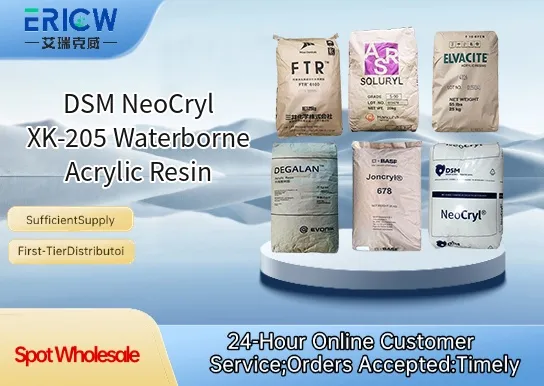
Low-VOC, environmentally compliant acrylic dispersion meeting global regulatory requirements including EPA and EU REACH.
Excellent film formation at ambient temperature without coalescing agents.
Superior scrub resistance and durability for demanding architectural and industrial coatings.
Good compatibility with common waterborne additives and crosslinkers (e.g., melamine, aziridines).
Stable rheology profile enabling easy formulation with conventional thickeners and high-shear processing.
High-performance interior and exterior architectural wall paints.
Waterborne industrial maintenance coatings for metal substrates.
Clear topcoats for wood and concrete protection systems.
Low-odor, zero-VOC decorative finishes for healthcare and education facilities.
Base resin for hybrid waterborne alkyd-acrylic blends.
| Chemical Type | Acrylic copolymer dispersion |
| Product Form | White to slightly bluish opaque liquid |
| Appearance | Homogeneous, low-viscosity dispersion |
| Solids Content (wt%) | 48 ± 1% |
| pH | 8.0 – 9.0 |
| Minimum Film Formation Temperature (MFFT) | ≤ 10 °C |
| Particle Size (D50) | ~120 nm |
| Primary Applications | Architectural coatings, industrial maintenance, clear protective coatings |
Q1: What is the primary application area for NeoCryl XK-205?
A: NeoCryl XK-205 is primarily formulated into high-performance waterborne architectural and industrial maintenance coatings, where excellent block resistance, low-temperature film formation, and good scrub resistance are required.
Q2: Can NeoCryl XK-205 be used in exterior applications?
A: Yes — it delivers good UV stability and hydrolytic resistance, making it suitable for exterior-grade topcoats and primers when properly formulated with appropriate pigments, additives, and coalescents.
Q3: How does NeoCryl XK-205 compare to solvent-based acrylic resins in terms of VOC content?
A: As a waterborne system, NeoCryl XK-205 enables formulators to significantly reduce VOC emissions compared to conventional solvent-based acrylics, supporting compliance with evolving environmental regulations and sustainability goals.
Q4: Is NeoCryl XK-205 compatible with common waterborne additives and crosslinkers?
A: It exhibits good compatibility with standard anionic and nonionic surfactants, defoamers, rheology modifiers, and melamine-formaldehyde or aziridine crosslinkers — though compatibility testing under specific formulation conditions is recommended.
Contact With Us:
E-mail: wangxingqiang@ericwchem.com
Have a Questions? Call Us:
Add:
Building A1, Jiete Industrial Park, Huangpu District, Guangzhou City, Guangdong Province, China