English
 Español
 tiếng việt
 русский
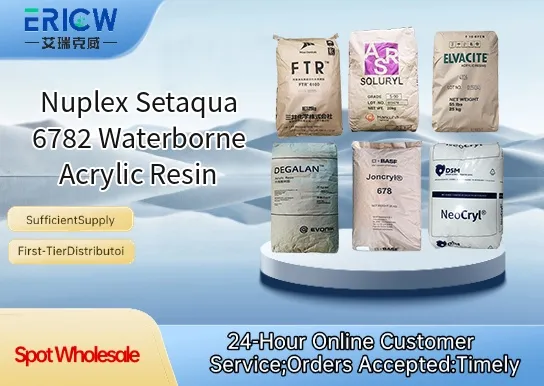
Low-VOC, environmentally compliant formulation meeting stringent global regulatory requirements.
Excellent film formation at ambient temperature without coalescing agents.
Superior water resistance and alkali stability in formulated coatings.
Good pigment wetting and dispersion stability for high-gloss architectural and industrial finishes.
Compatible with common crosslinkers (e.g., melamine, aziridine) for enhanced durability.
Architectural interior and exterior wall paints.
Industrial maintenance coatings for metal substrates.
Waterborne wood coatings requiring clarity and adhesion.
High-performance concrete sealers and protective topcoats.
Basecoats for low-bake OEM and refinish applications.
| Chemical Type | Acrylic copolymer emulsion |
| Product Form | White to slightly bluish opaque liquid |
| Appearance | Uniform, free from gel particles and sediment |
| Solids Content (wt%) | 45.0 ± 1.0% |
| pH (at 25°C) | 8.0 – 9.0 |
| Minimum Film Formation Temperature (MFFT) | ≈ 15°C |
| Viscosity (Brookfield RVT, #2 spindle, 20 rpm, 25°C) | 100 – 300 mPa·s |
| Particle Size (D50) | 120 – 180 nm |
Q1: What are the primary application areas for Setaqua 6782?
A: Setaqua 6782 is commonly used in high-performance waterborne industrial coatings, including metal primers, topcoats for general industrial applications, and protective coatings where low VOC, good corrosion resistance, and balanced film formation are required.
Q2: How does Setaqua 6782 perform in terms of freeze-thaw stability?
A: As a stable anionic acrylic dispersion, Setaqua 6782 exhibits good freeze-thaw stability when stored under recommended conditions — typically surviving at least three standard freeze-thaw cycles without significant viscosity change or coagulation, provided it is not exposed to prolonged sub-zero temperatures or repeated freezing.
Q3: Can Setaqua 6782 be blended with other resins or crosslinkers?
A: Yes, Setaqua 6782 is compatible with many common waterborne resins such as polyurethane dispersions and epoxy-modified acrylics, and can be formulated with ambient-cure or thermally activated crosslinkers like aziridines, carbodiimides, or melamine-formaldehyde derivatives — compatibility and stability should always be verified experimentally in the final formulation.
Q4: What is the typical pH range and how should it be adjusted if needed?
A: The resin is supplied with a pH typically between 7.5 and 9.0. Minor pH adjustments may be made using diluted ammonia or organic amines; however, strong mineral acids or excessive base should be avoided to prevent destabilization of the dispersion.
Contact With Us:
E-mail: wangxingqiang@ericwchem.com
Have a Questions? Call Us:
Add:
Building A1, Jiete Industrial Park, Huangpu District, Guangzhou City, Guangdong Province, China