English
 Español
 tiếng việt
 русский
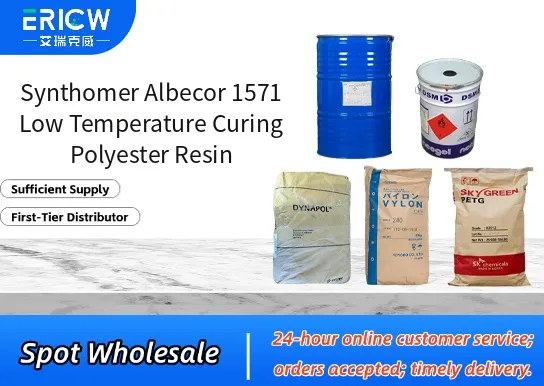
Enables full cure at ambient to mildly elevated temperatures (as low as 15–25 °C with appropriate catalyst), reducing energy consumption and thermal stress on substrates.
Offers excellent flexibility and impact resistance in cured films, supporting durable performance on dynamic or thermally cycled surfaces.
Provides good adhesion to a wide range of substrates including metals, plastics, and composites without requiring aggressive primers.
Exhibits low volatile organic compound (VOC) content, supporting compliance with stringent environmental and occupational health regulations.
Delivers balanced pot life and rapid development of handling strength, optimizing production throughput in industrial coating and laminating operations.
Low-bake coil coatings for pre-painted metal used in architectural panels and appliance housings.
Industrial maintenance coatings for offshore structures, pipelines, and field-repaired equipment where hot curing is impractical.
Composite matrix resin for fiber-reinforced plastic (FRP) parts requiring dimensional stability during low-temperature fabrication.
Protective topcoats for heat-sensitive substrates such as PVC profiles, thermoplastic composites, and electronic enclosures.
Adhesive primers and tie-coats in multi-layer laminates for transportation and renewable energy applications.
| Chemical Type | Unsaturated polyester resin |
| Product Form | Liquid, solvent-free or low-solvent formulation |
| Appearance | Clear to pale yellow viscous liquid |
| Primary Applications | Low-temperature curable coatings, laminates, and adhesive systems |
| Key Features | Ambient-to-moderate temperature cure, flexible film formation, substrate versatility |
| Benefits | Energy efficiency, reduced substrate distortion, improved workplace safety, regulatory compliance |
| Catalyst Requirement | Requires peroxide initiator (e.g., MEKP) for room-temperature or warm-cure activation |
| Storage Stability | 12 months at ≤25 °C in sealed, original container |
Q1: What is the primary advantage of using Albecor 1571 in low-temperature curing applications?
A: Albecor 1571 is specifically engineered to enable efficient crosslinking of polyester-based coatings and adhesives at reduced temperatures—typically below 100 °C—without compromising film integrity, hardness development, or chemical resistance. This supports energy-efficient processing and enables use on heat-sensitive substrates such as certain plastics, composites, or pre-assembled components.
Q2: Is Albecor 1571 compatible with standard polyester resins and common curing catalysts?
A: Yes, Albecor 1571 is formulated for broad compatibility with conventional unsaturated polyester resins and works effectively with widely used peroxide initiators (e.g., MEKP, BPO) as well as latent amine or metal-based catalysts. Compatibility and cure profile should be verified in the final formulation due to potential interactions with fillers, pigments, or other additives.
Q3: Can Albecor 1571 be used in coatings requiring flexibility and impact resistance?
A: Yes—its molecular architecture contributes to balanced rigidity and chain mobility, supporting formulations where moderate flexibility, substrate adhesion, and impact resistance are required alongside good surface hardness. Performance in this regard is optimized when blended with appropriately selected polyester backbones and plasticizers, if needed.
Q4: How should Albecor 1571 be stored and handled to maintain stability?
A: Store in original sealed containers in a cool, dry, and well-ventilated area away from direct sunlight, heat sources, and strong oxidizers. Prolonged exposure to elevated temperatures or moisture may affect shelf life and reactivity. Always follow standard industrial handling practices for reactive organic resins, including appropriate personal protective equipment.
Contact With Us:
E-mail: wangxingqiang@ericwchem.com
Have a Questions? Call Us:
Add:
Building A1, Jiete Industrial Park, Huangpu District, Guangzhou City, Guangdong Province, China