English
 Español
 tiếng việt
 русский
High-gloss, excellent flow and leveling for premium surface aesthetics.
Outstanding weather resistance and UV stability for long-term outdoor performance.
Good chemical resistance to solvents, acids, and alkalis in cured coatings.
Compatible with standard TGIC and hydroxyalkylamide (HAA) curing agents.
Low melt viscosity enabling efficient extrusion and high transfer efficiency in powder coating processes.
Architectural aluminum extrusions for façades and curtain walls.
Outdoor furniture and garden equipment requiring durable finish integrity.
Agricultural and construction machinery components exposed to harsh environments.
Residential and commercial metal doors, windows, and railings.
| Chemical Type | Carboxyl-functional saturated polyester |
| Product Form | Pale yellow to light amber solid granules |
| Appearance | Free-flowing, homogeneous granules |
| Acid Value (mg KOH/g) | 26–30 |
| Melt Viscosity (Pa·s, @ 180 °C) | 3,500–4,500 |
| Gardner Color (on 50% w/w solution in MEK) | ≤ 3 |
| Primary Applications | Exterior-grade TGIC-free and TGIC-based powder coatings |
| Key Features | Weather durability, gloss retention, mechanical toughness |
Q1: What is the primary application of CRYLCOAT 1713-1 in powder coatings?
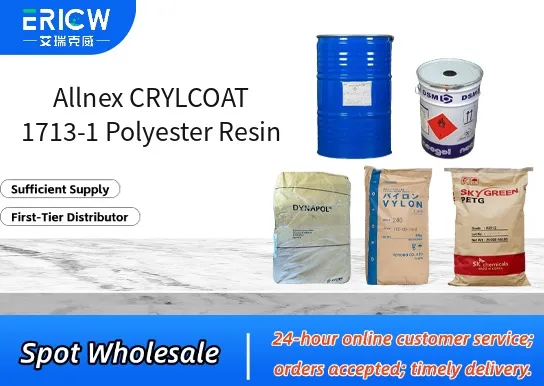
A: CRYLCOAT 1713-1 is a carboxyl-functional polyester resin designed for use in TGIC-free and HAA-cured architectural and industrial powder coating systems, offering good flow, gloss retention, and weather resistance.
Q2: Is CRYLCOAT 1713-1 compatible with standard curing agents used in polyester-based powder coatings?
A: Yes — it is formulated to react efficiently with common crosslinkers such as hydroxyalkyl amides (HAA) and alternative TGIC-free systems, providing robust cure response under typical industrial baking conditions (e.g., 180–200 °C for 10–20 minutes).
Q3: How does CRYLCOAT 1713-1 perform in terms of UV stability and long-term outdoor durability?
A: As a high-purity, low-impurity aromatic polyester, it delivers excellent resistance to chalking, gloss loss, and color shift when properly formulated and cured — making it suitable for exterior applications requiring extended service life.
Q4: Can CRYLCOAT 1713-1 be blended with other resins to modify film properties?
A: Yes — it is commonly blended with other polyester resins or acrylics to fine-tune flexibility, hardness, or curing speed, though compatibility and final performance should be verified through small-scale formulation trials.
Contact With Us:
E-mail: wangxingqiang@ericwchem.com
Have a Questions? Call Us:
Add:
Building A1, Jiete Industrial Park, Huangpu District, Guangzhou City, Guangdong Province, China