English
 Español
 tiếng việt
 русский
High hydroxyl functionality for efficient crosslinking with melamine and polyisocyanate curing agents.
Excellent compatibility with common solventborne and high-solids coating systems.
Superior gloss retention and weather resistance in exterior topcoat applications.
Low viscosity profile enabling high-solids formulation without excessive solvent demand.
Consistent batch-to-batch reproducibility meeting stringent automotive OEM requirements.
Automotive OEM clearcoats and basecoats.
Industrial maintenance coatings for metal substrates.
General-purpose high-performance protective topcoats.
Refinish coatings requiring excellent sandability and film integrity.
Plastic coatings for automotive interior and exterior trim.
| Chemical Type | Hydroxyl-functional acrylic copolymer |
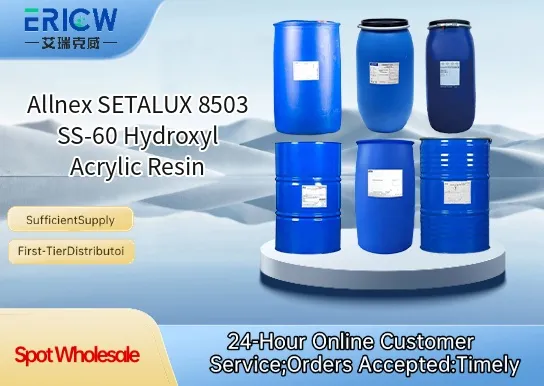
| Product Form | Liquid resin solution |
| Appearance | Clear, pale yellow liquid |
| Primary Applications | High-solids thermoset coatings, automotive and industrial topcoats |
| Key Features | High OH value, low VOC potential, excellent flow and leveling |
| Benefits | Enhanced crosslink density, improved chemical resistance, reduced bake time |
| Solvent System | Typically xylene / butyl acetate / PGMEA blend (customizable) |
| Storage Stability | ≥12 months at 25°C in sealed container |
Q1: What is the primary function of SETALUX 8503 SS-60 in coating formulations?
A: SETALUX 8503 SS-60 serves as a hydroxyl-functional acrylic resin designed to act as a reactive binder in two-component polyurethane (2K PU) and other crosslinking systems. It contributes to film formation, enhances hardness and chemical resistance, and supports excellent gloss retention and weatherability in high-performance industrial and automotive topcoats.
Q2: Is SETALUX 8503 SS-60 compatible with common isocyanate crosslinkers?
A: Yes — it is specifically engineered for compatibility with aliphatic isocyanate crosslinkers, including HDI-based trimer and biuret types. Its hydroxyl functionality ensures efficient curing at ambient or elevated temperatures, delivering robust mechanical and durability properties without compromising pot life when properly formulated.
Q3: How does SETALUX 8503 SS-60 support low-VOC formulation goals?
A: As a solvent-borne resin with relatively low aromatic content and good solubility in common low-to-moderate polarity solvents (e.g., esters, ketones, glycol ethers), it enables formulators to reduce or eliminate high-VOC solvents such as xylene or toluene. Its molecular design also supports higher solids content without excessive viscosity build, facilitating VOC-compliant 2K PU systems.
Q4: Can this resin be used in both air-dry and forced-cure applications?
A: While SETALUX 8503 SS-60 requires a crosslinker to fully develop its performance profile, it is suitable for both ambient-cure and thermal-cure conditions. Formulations can be optimized for room-temperature development of initial handling strength, with final properties enhanced through moderate bake cycles (e.g., 60–80 °C), depending on the selected isocyanate and catalyst system.
Contact With Us:
E-mail: wangxingqiang@ericwchem.com
Have a Questions? Call Us:
Add:
Building A1, Jiete Industrial Park, Huangpu District, Guangzhou City, Guangdong Province, China