English
 Español
 tiếng việt
 русский
Excellent abrasion resistance for demanding mechanical service environments.
Outstanding oil and grease resistance, maintaining performance in lubricated or hydrocarbon-exposed conditions.
High tensile strength and elongation at break, enabling robust dynamic part functionality.
Good low-temperature flexibility down to –30 °C without significant stiffness increase.
Compatible with standard thermoplastic processing methods including extrusion, injection molding, and calendering.
Industrial drive belts and power transmission components.
High-wear seals, gaskets, and hydraulic system elastomeric parts.
Automotive interior trim overlays and soft-touch functional surfaces.
Flexible hose and tubing for pneumatic and fluid handling systems.
Roller coverings and conveyor components requiring resilience and grip.
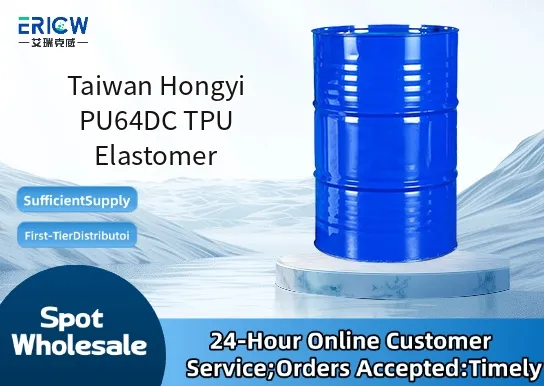
| Chemical Type | Polyester-based thermoplastic polyurethane (TPU) |
| Product Form | Free-flowing granules |
| Appearance | Off-white to light amber translucent pellets |
| Shore A Hardness (ASTM D2240) | 64 ± 2 |
| Melt Flow Index (210 °C/10 kg, ASTM D1238) | 15–22 g/10 min |
| Density (ASTM D792) | 1.18–1.20 g/cm³ |
| Ultimate Tensile Strength (ASTM D412) | ≥35 MPa |
| Elongation at Break (ASTM D412) | ≥500% |
Q1: What is the primary application field for PU64DC?
A: PU64DC is a high-clarity, low-viscosity thermoplastic polyurethane elastomer specifically engineered for solvent-based and UV-curable coatings, overprint varnishes, and functional topcoats—especially where excellent substrate adhesion, flexibility, and abrasion resistance are required on plastics, films, and printed surfaces.
Q2: Is PU64DC compatible with common coating resins and solvents?
A: Yes, PU64DC demonstrates broad compatibility with acrylics, polyesters, cellulose derivatives, and standard organic solvents such as ethyl acetate, isopropanol, and toluene. It is also widely used in hybrid systems with UV monomers and oligomers, though compatibility testing under specific formulation conditions is recommended.
Q3: How does PU64DC enhance film performance in flexible packaging coatings?
A: PU64DC improves toughness, scratch resistance, and low-temperature flexibility without compromising optical clarity or printability. Its inherent elasticity helps maintain coating integrity during lamination, slitting, and form-fill-seal processes, reducing micro-cracking and delamination risks on soft substrates.
Q4: What is the typical dosage range when using PU64DC as a modifier?
A: As a performance modifier, PU64DC is typically used at low concentrations—generally ranging from 0.1% to 2% by weight of the total formulation—depending on the desired balance of flexibility, adhesion, and surface hardness. Optimal dosage should be determined through lab-scale evaluation of end-use requirements.
Contact With Us:
E-mail: wangxingqiang@ericwchem.com
Have a Questions? Call Us:
Add:
Building A1, Jiete Industrial Park, Huangpu District, Guangzhou City, Guangdong Province, China