English
 Español
 tiếng việt
 русский
Excellent melt processability for high-speed extrusion and injection molding.
Outstanding abrasion resistance and mechanical toughness at ambient and elevated temperatures.
Good hydrolytic stability, suitable for humid or wet-end processing environments.
Low-temperature flexibility with retained elasticity down to –40 °C.
Compatible with common plasticizers and additives for formulation tuning.
Wire and cable jacketing requiring flexibility, cut-through resistance, and flame-retardant compatibility.
Automotive interior trim components including soft-touch overlays and air ducts.
Industrial hoses and fluid transfer tubing demanding kink resistance and pressure retention.
Medical-grade tubing and connectors meeting ISO 10993 biocompatibility screening requirements.
Consumer electronics protective casings and wearable device components.
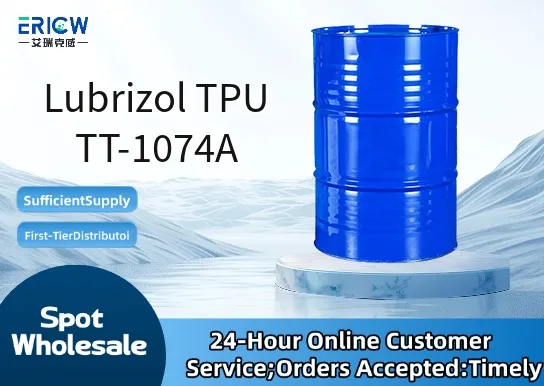
| Chemical Type | Thermoplastic Polyurethane (Aliphatic Polyester-based) |
| Product Form | Pellets |
| Appearance | Off-white to light tan, free-flowing pellets |
| Primary Applications | Extruded profiles, injection-molded parts, blow-molded articles |
| Key Features | Melt flow index (230 °C/2.16 kg): 12–18 g/10 min |
| Benefits | Balanced stiffness–toughness profile with low compression set |
| Processing Temperature Range | 180–220 °C (barrel), 30–50 °C (mold) |
| Storage Conditions | Store in dry, ventilated area at <25 °C; protect from moisture |
Q1: What is Lubrizol TPU TT-1074A primarily used for?
A: Lubrizol TPU TT-1074A is a thermoplastic polyurethane-based additive designed to enhance melt processability, surface finish, and low-temperature flexibility in TPU compounds—particularly in extruded and injection-molded applications such as cables, tubing, and soft-touch overmolds.
Q2: Is TT-1074A compatible with all TPU chemistries?
A: TT-1074A demonstrates broad compatibility with aromatic and aliphatic polyester- and polyether-based TPUs. Performance optimization may require minor formulation adjustments depending on the base polymer’s molecular weight, hardness, and processing history.
Q3: How is TT-1074A typically incorporated into TPU formulations?
A: It is commonly introduced via dry blending prior to extrusion or by direct feeding into the hopper of twin-screw extruders. Pre-compounding at moderate shear ensures uniform dispersion without thermal degradation.
Q4: Does TT-1074A affect the regulatory compliance status of finished TPU articles?
A: TT-1074A is intended for industrial use in non-food-contact applications unless otherwise validated. Formulators are responsible for confirming final article compliance with applicable regional regulations, as performance and safety assessments depend on the full system composition and end-use conditions.
Q5: What processing benefits can be expected when using TT-1074A?
A: Users commonly report reduced melt viscosity, improved die swell control, enhanced surface gloss, and better dimensional stability during cooling—especially in thin-walled or high-detail parts processed at elevated throughput rates.
Contact With Us:
E-mail: wangxingqiang@ericwchem.com
Have a Questions? Call Us:
Add:
Building A1, Jiete Industrial Park, Huangpu District, Guangzhou City, Guangdong Province, China