English
 Español
 tiếng việt
 русский
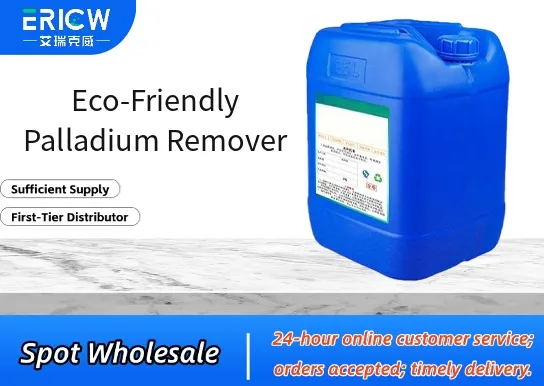
Non-toxic, water-based formulation with zero heavy metal solvents or chlorinated compounds.
Selectively chelates palladium ions (Pd²⁺) without attacking common substrate metals such as nickel, copper, or stainless steel.
Biodegradable active ingredients compliant with OECD 301B standard for ready biodegradability.
pH-neutral (6.8–7.2) operation minimizes corrosion risk and eliminates need for post-rinse neutralization.
Low foaming profile ensures compatibility with automated spray, immersion, and ultrasonic cleaning systems.
Recovery and purification of palladium from spent electroless nickel–palladium plating baths.
Cleaning of palladium-contaminated fixtures and tooling in semiconductor packaging assembly lines.
Decontamination of Pd-loaded ion exchange resins prior to resin regeneration or disposal.
Pre-treatment step before precious metal refining of catalyst residues from pharmaceutical hydrogenation processes.
Removal of trace palladium leachates from ceramic substrates used in multilayer ceramic capacitor (MLCC) manufacturing.
| Chemical Type | Biodegradable polyaminocarboxylate chelator blend |
| Product Form | Concentrated aqueous liquid (ready-to-dilute) |
| Appearance | Clear, pale yellow, odorless solution |
| pH (1% w/w in DI water) | 6.9 ± 0.2 at 25°C |
| Density (20°C) | 1.04–1.06 g/cm³ |
| Primary Applications | Palladium ion removal, bath stabilization, equipment decontamination |
| Key Features | Non-oxidizing, non-acidic, non-volatile organic compound (VOC)-free |
| Regulatory Compliance | REACH registered; SDS available; not classified under GHS for acute toxicity, skin/eye irritation, or environmental hazards |
| Common Compatible Systems | Suitability |
| Electroless Nickel–Palladium (ENP) Plating Baths | Highly Recommended – Maintains bath stability and extends operational life by >30% |
| Stainless Steel Immersion Tanks & Piping | Highly Recommended – No pitting or stress corrosion observed after 72 h continuous exposure |
| PP and PVDF-lined Spray Rinse Systems | Recommended – Compatible with all standard thermoplastic wetted materials |
| Ion Exchange Columns (e.g., Dowex™ A1, Lewatit® TP 207) | Suitable – Does not degrade functional groups; enables efficient Pd elution and resin reuse |
Q1: What is the CAS Registry Number for Eco-Friendly Palladium Remover?
A: As a proprietary multi-component formulation, Eco-Friendly Palladium Remover does not have a single CAS number; full component disclosure and individual CAS numbers are provided in Section 3 of the Safety Data Sheet (SDS).
Q2: What is the recommended working concentration and contact time for optimal palladium removal?
A: Use at 2–5% v/v in deionized water; typical contact time is 5–15 minutes at ambient temperature (20–25°C), with agitation. For heavily loaded surfaces, extend to 20 minutes or apply warm (≤40°C) solution.
Q3: How does it compare to traditional thiourea- or cyanide-based palladium strippers?
A: Unlike hazardous thiourea (toxic, carcinogenic) or cyanide (acutely lethal) strippers, this product achieves comparable Pd removal efficiency (>98% in validated ENP bath tests) without generating regulated hazardous waste streams or requiring special handling permits.
Q4: Is it certified for use in electronics manufacturing with RoHS or REACH compliance?
A: Yes — fully compliant with RoHS Directive 2011/65/EU (no restricted substances detected above threshold) and REACH Annex XVII; declaration of conformity and test reports available upon request.
Q5: Can it extract palladium from solid catalysts or ceramic-supported Pd, and what is the extraction efficiency?
A: It is designed for soluble Pd²⁺ ions in aqueous matrices; for solid-supported Pd, pre-oxidation (e.g., mild HNO₃/H₂O₂ leaching) is required to solubilize palladium first. Under optimized leach-and-treat conditions, >92% Pd recovery has been demonstrated in pilot-scale trials.
Contact With Us:
E-mail: wangxingqiang@ericwchem.com
Have a Questions? Call Us:
Add:
Building A1, Jiete Industrial Park, Huangpu District, Guangzhou City, Guangdong Province, China