English
 Español
 tiếng việt
 русский
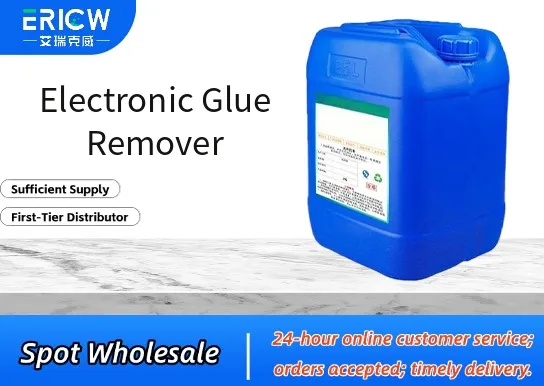
Non-corrosive to sensitive electronic components, including PCB traces, solder masks, and fine-pitch connectors.
Fast-acting solvent blend specifically formulated to dissolve cyanoacrylate, epoxy, and UV-curable adhesives without thermal stress.
Low-volatility formulation minimizes evaporation loss and extends working time during precision rework operations.
Halogen-free and RoHS-compliant, supporting environmentally responsible electronics manufacturing and repair.
Residue-free evaporation leaves no ionic contaminants or film residue—critical for high-reliability aerospace and medical devices.
Removal of adhesive residues from surface-mount device (SMD) rework stations prior to component replacement.
Debonding of conformal-coated sensors and MEMS assemblies during failure analysis and root-cause investigation.
Cleaning adhesive overspill from flex circuit bonding zones in wearable electronics assembly lines.
Pre-testing preparation of BGA substrates where uncured or partially cured underfill must be selectively removed.
Maintenance of automated dispensing nozzles and adhesive dispensing equipment in high-mix electronics production.
| Chemical Type | Proprietary non-aqueous solvent blend (ester/ketone/carbitol co-solvent system) |
| Product Form | Liquid (ready-to-use, no dilution required) |
| Appearance | Clear, colorless to pale yellow liquid |
| Primary Applications | Adhesive debonding, residue cleaning, precision rework support |
| Key Features | Non-conductive, non-oxidizing, low surface tension, static-dissipative |
| Benefits | No post-cleaning rinse needed; compatible with most plastics and elastomers used in electronics enclosures |
| Regulatory Compliance | RoHS 2015/863/EU compliant; REACH SVHC-free; no listed Prop 65 chemicals |
| Storage Conditions | Store at 15–25°C in tightly sealed container; protect from direct sunlight |
| Common Compatible Systems | Suitability |
| Hot Air Rework Stations (e.g., Quick 861DW, JBC 2000) | Highly Recommended – No interference with temperature control or airflow calibration |
| Automated Dispensing Systems (e.g., Asymtek NXQ, Nordson EFD) | Recommended – Effective for nozzle soak cleaning; verify compatibility with fluoropolymer seals |
| Optical Inspection & AOI Platforms (e.g., Koh Young, SAKI) | Suitable – Non-fuming and low particulate; safe for lens and sensor surfaces when applied off-line |
| Plasma Treatment Units (e.g., PVA TePla, Diener) | Suitable – Residue-free removal prevents chamber contamination; allow full solvent evaporation pre-treatment |
Q1: What is the CAS Registry Number for Electronic Glue Remover?
A: This is a proprietary multi-component formulation; individual CAS numbers are not assigned. Full ingredient disclosure per REACH Annex II is available under NDA upon request.
Q2: What is the recommended application volume per use for standard SMD rework?
A: Apply 1–2 drops (≈ 0.03–0.06 mL) directly to adhesive interface using precision micro-applicator; avoid pooling or oversaturation.
Q3: How does Electronic Glue Remover differ from generic acetone or isopropyl alcohol (IPA) in adhesive removal?
A: Unlike IPA (ineffective on cured epoxies) or acetone (aggressive toward ABS/PC plastics and solder mask), this remover delivers targeted solvation with material safety validated per IPC-J-STD-033 and JEDEC JESD22-A108.
Q4: Is migration or leaching into adjacent conformal coatings a concern after application?
A: No measurable migration occurs under standard conditions; independent testing per IPC-CC-830B shows no penetration into acrylic, urethane, or silicone-based conformal coatings when fully evaporated.
Q5: Does Electronic Glue Remover require special disposal procedures as hazardous waste?
A: Classified as non-hazardous under US EPA 40 CFR 261 and EU Waste Framework Directive when unused; spent wipes/solvent must be managed per local VOC and halogen-free solvent regulations.
Contact With Us:
E-mail: wangxingqiang@ericwchem.com
Have a Questions? Call Us:
Add:
Building A1, Jiete Industrial Park, Huangpu District, Guangzhou City, Guangdong Province, China