English
 Español
 tiếng việt
 русский
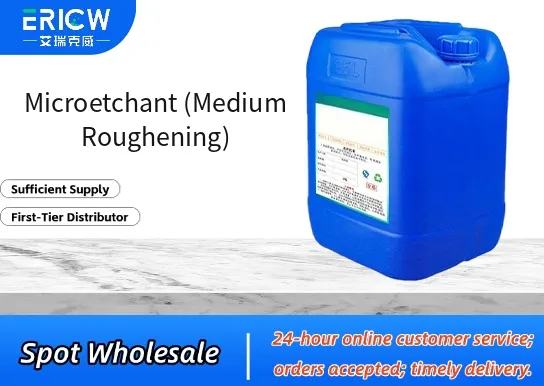
Precisely engineered for controlled, uniform medium-level surface roughening of copper and copper alloys.
Non-cyanide, sulfate-based formulation ensuring improved workplace safety and reduced environmental impact.
Stable bath performance with extended operational life and minimal drag-out sensitivity.
Optimized for consistent micro-roughness (Ra 0.5–1.2 µm) without undercutting or pitting.
Compatible with automated conveyorized and batch immersion systems across standard PCB manufacturing lines.
Inner-layer copper pretreatment prior to dry film or liquid photoresist lamination in multilayer PCB fabrication.
Surface activation of copper foils for enhanced adhesion in HDI (High-Density Interconnect) substrates.
Roughening of copper-clad laminates before bonding in rigid-flex and flex circuit assembly.
Pre-etch conditioning step for copper surfaces prior to electroless nickel immersion gold (ENIG) plating.
Micro-roughening of copper traces in advanced packaging substrates requiring reliable die attach adhesion.
| Chemical Type | Sulfate-based non-cyanide microetchant |
| Product Form | Concentrated aqueous liquid (ready-to-dilute) |
| Appearance | Clear to slightly hazy pale blue solution |
| pH (as supplied) | 1.8–2.4 (at 25°C) |
| Primary Applications | Copper surface micro-roughening for adhesion promotion |
| Key Features | Controlled etch rate, low copper dissolution variability, no heavy metal additives |
| Benefits | Reduced sludge formation, stable bath chemistry, lower rinse water demand |
| Regulatory Compliance | REACH SVHC-free; RoHS 3 compliant; SDS available per ISO 45001 guidelines |
| Common Compatible Systems | Suitability |
| Vertical Conveyor Etching Lines (e.g., Technic, Atotech, MacDermid Enthone) | Highly Recommended – Optimized for flow dynamics and temperature control at 25–35°C |
| Batch Immersion Tanks with Air Agitation | Recommended – Requires pH and temperature monitoring; ideal for R&D and low-volume production |
| Inline Spray Etch Systems (low-pressure, dual-nozzle) | Suitable – Effective with modified nozzle patterns and dwell time ≥ 60 sec |
| Recirculating Filtration Units (1–5 µm cartridge filters) | Highly Recommended – Prevents particulate buildup and maintains bath clarity |
Q1: What is the CAS Registry Number for Microetchant (Medium Roughening)?
A: This is a proprietary multi-component formulation; individual CAS numbers are not assigned to the final product. Full ingredient disclosure with CAS identifiers is provided in Section 3 of the Safety Data Sheet (SDS).
Q2: What is the recommended working concentration and typical dwell time?
A: Dilute 8–12% v/v in deionized water; operate at 25–35°C with air or mechanical agitation. Standard dwell time is 60–120 seconds, adjustable based on target Ra and copper thickness.
Q3: How does this medium-roughening microetchant differ from high-roughness or low-roughness alternatives?
A: It delivers balanced topography — higher Ra than low-roughness types (e.g., for oxide replacement) but lower peak height and narrower distribution than aggressive high-roughness etchants, minimizing risk of resist lifting or micro-cracking during thermal cycling.
Q4: Is this product compliant with EU ELV and China RoHS for automotive electronics?
A: Yes — it contains no lead, mercury, cadmium, hexavalent chromium, PBBs, PBDEs, DEHP, BBP, DBP, or DIBP above threshold limits. Certificate of Conformance available upon request.
Q5: Does Microetchant (Medium Roughening) pose extractable or leachable residue concerns in medical-grade PCB assemblies?
A: No detectable ionic residues remain after standard post-etch DI rinse (≥ 6 min) and hot air drying. Validated per IPC-TM-650 2.3.25 (Ionic Contamination Test) and USP <87>/<88> cytotoxicity screening protocols.
Contact With Us:
E-mail: wangxingqiang@ericwchem.com
Have a Questions? Call Us:
Add:
Building A1, Jiete Industrial Park, Huangpu District, Guangzhou City, Guangdong Province, China