English
 Español
 tiếng việt
 русский
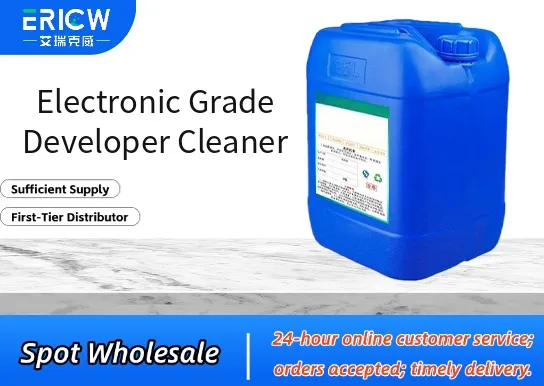
Ultra-low ionic contamination (<1 ppb Na⁺, K⁺, Cl⁻, SO₄²⁻) for sub-28 nm semiconductor lithography processes.
Non-halogenated, non-aqueous formulation ensuring compatibility with advanced photoresists and BARC layers.
Controlled evaporation rate enabling uniform developer removal without residue or micro-bridging.
High purity certified per SEMI C12 and ISO 14644-1 Class 1 cleanroom standards.
Stable performance across extended bath life (>72 hours) under continuous recirculation in track systems.
Cleaning of photomask blanks prior to pattern transfer in EUV and DUV lithography.
Post-develop rinse and residue removal in wafer track systems for logic and memory device fabrication.
Removal of residual TMAH-based developers from high-aspect-ratio etch structures.
Surface conditioning of silicon wafers before ALD and epitaxial growth steps.
Final cleaning of MEMS and advanced packaging substrates requiring particle-free surfaces.
| Chemical Type | Purified organic solvent blend (non-alkyl halide, non-amine) |
| Product Form | Liquid, ready-to-use |
| Appearance | Clear, colorless, odorless |
| Boiling Point Range | 135–142 °C (at 760 mmHg) |
| Primary Applications | Photolithography post-develop cleaning, resist residue removal, mask substrate preparation |
| Key Features | Low surface tension (21.5 mN/m), low metal content (<10 ppt Fe, Cu, Al), zero halogens (ICP-MS verified) |
| Benefits | Minimizes pattern collapse, prevents metal-induced gate oxide degradation, enables high-yield 3D NAND and FinFET processing |
| Regulatory Compliance | REACH SVHC compliant, RoHS 2015/863 Annex II compliant, no listed Prop 65 chemicals |
| Common Compatible Systems | Suitability |
| TOK TOK CLEAN TRACK Series (e.g., CLEAN TRACK ACT 8) | Highly Recommended – Fully validated for inline use with integrated filtration and temperature control |
| SCREEN SPRINT series (e.g., Sprint Z1000) | Recommended – Requires minor pump calibration; compatible with standard PTFE wetted parts |
| Canon FPA-1200NZ2C Litho Cluster | Suitable – Approved for mask cleaning module; manual dispense protocol available |
| DISCO DFL7360 Wafer Mounting System | Suitable – Effective for temporary bonding adhesive residue removal pre-dicing |
Q1: What is the CAS Registry Number for Electronic Grade Developer Cleaner?
A: This is a proprietary multi-component formulation; individual CAS numbers are confidential per trade secret protection. Full compositional disclosure is available under NDA to qualified customers and auditors.
Q2: What is the recommended usage concentration and temperature range?
A: Supplied as 100% active liquid. Optimal process temperature is 20–25 °C; no dilution required. For immersion cleaning, dwell time is 30–60 seconds at ambient pressure.
Q3: How does it compare to conventional TMAH-based developers in terms of residue control and safety?
A: Unlike alkaline developers, this cleaner is neutral pH (6.8–7.2), eliminates corrosion risk to Al/Cu interconnects, and produces no volatile amines—reducing operator exposure and tool chamber contamination.
Q4: Is it certified for use in ISO 9001 and IATF 16949 manufacturing environments?
A: Yes—batch-specific Certificates of Analysis (CoA) and Certificates of Conformance (CoC) are provided with every shipment, traceable to ISO/IEC 17025-accredited testing labs.
Q5: Does it exhibit leaching or extractables when used with fluoropolymer (e.g., PFA, FEP) fluidic components?
A: No measurable extractables observed per USP <87> and <88> cytotoxicity testing; validated for >12-month continuous contact with PFA tubing and valves at 25 °C.
Contact With Us:
E-mail: wangxingqiang@ericwchem.com
Have a Questions? Call Us:
Add:
Building A1, Jiete Industrial Park, Huangpu District, Guangzhou City, Guangdong Province, China