English
 Español
 tiếng việt
 русский
High clarity and excellent UV resistance for long-term optical stability.
Good melt flow characteristics enabling efficient extrusion and injection molding processing.
Excellent surface hardness and scratch resistance without requiring post-curing.
Low moisture absorption, ensuring dimensional stability in humid environments.
Compatible with common plasticizers and impact modifiers for tailored performance enhancement.
Transparent automotive lighting lenses and bezels.
Medical device housings requiring sterilization compatibility and optical clarity.
Architectural glazing and light-diffusing panels.
Consumer electronics front covers and display windows.
Signage and illuminated advertising components.
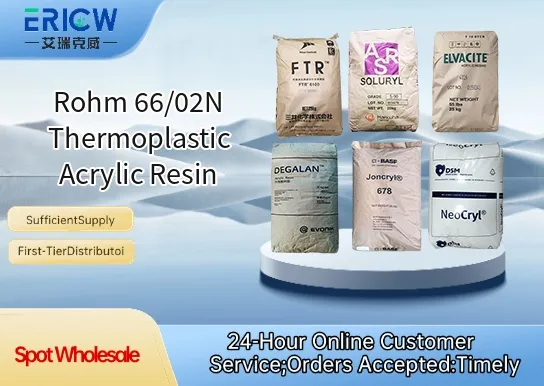
| Chemical Type | Thermoplastic Poly(methyl methacrylate) (PMMA) |
| Product Form | Pellets |
| Appearance | White, free-flowing granules |
| Melt Flow Index (230 °C / 3.8 kg) | 8–12 g/10 min |
| Density (23 °C) | 1.18–1.20 g/cm³ |
| Water Absorption (24 h, 23 °C) | 0.3–0.4 wt% |
| Vicat Softening Temperature | 105–108 °C |
| Transmittance (3 mm thickness) | ≥92% (at 550 nm) |
Q1: What are the primary processing methods suitable for Rohm 66/02N?
A: Rohm 66/02N is designed for melt-processing techniques including extrusion, injection molding, and compression molding. Its thermoplastic nature enables good melt flow and reprocessability, making it well-suited for applications requiring dimensional stability and surface clarity.
Q2: How does Rohm 66/02N compare to thermosetting acrylic resins in terms of recyclability and reprocessing?
A: Unlike thermosetting acrylics, Rohm 66/02N is fully thermoplastic—meaning it softens upon heating and solidifies upon cooling without chemical crosslinking. This allows for multiple reprocessing cycles and integration into closed-loop manufacturing or post-industrial recycling streams, provided thermal history is controlled to maintain molecular integrity.
Q3: Is Rohm 66/02N compatible with common plasticizers or impact modifiers?
A: Yes, Rohm 66/02N demonstrates good compatibility with a range of standard plasticizers (e.g., phthalate- and adipate-based esters) and acrylic or methacrylic impact modifiers. Compatibility should be verified experimentally in the final formulation, as performance depends on additive polarity, molecular weight, and processing conditions.
Q4: Can Rohm 66/02N be used in applications requiring UV resistance and long-term weatherability?
A: Yes—Rohm 66/02N inherently offers excellent UV stability and resistance to yellowing due to its saturated carbon backbone and absence of hydrolyzable groups. It is commonly selected for outdoor-facing components where retention of gloss, color, and mechanical properties under prolonged sunlight exposure is critical.
Contact With Us:
E-mail: wangxingqiang@ericwchem.com
Have a Questions? Call Us:
Add:
Building A1, Jiete Industrial Park, Huangpu District, Guangzhou City, Guangdong Province, China