English
 Español
 tiếng việt
 русский
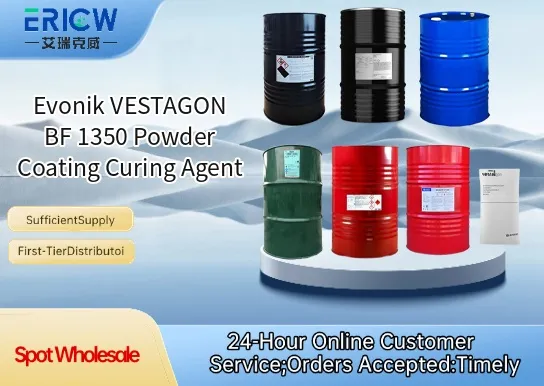
High reactivity with hydroxyl-functional polyester resins, enabling rapid cure at low temperatures (140–160 °C).
Excellent storage stability as a free-flowing powder, with no pre-reaction or self-condensation under ambient conditions.
Enables high-gloss, smooth film formation with outstanding mechanical properties and chemical resistance.
Low volatile organic compound (VOC) emission—fully compliant with stringent environmental regulations for powder coatings.
Consistent batch-to-batch performance ensured by Evonik’s controlled synthesis and stringent quality control.
Architectural aluminum profiles for façades, windows, and curtain walls.
Automotive exterior trim components requiring durable, weather-resistant finishes.
Domestic appliances such as refrigerators, ovens, and washing machines.
Office furniture and metal shelving systems demanding aesthetic consistency and scratch resistance.
General industrial metal parts including electrical enclosures and agricultural equipment housings.
| Chemical Type | Glycidyl-functionalized aliphatic amine adduct |
| Product Form | Free-flowing white to off-white crystalline powder |
| Appearance | Homogeneous granular powder, no lumps or dust agglomerates |
| Primary Applications | Curing agent for hydroxyl-functional polyester-based thermoset powder coatings |
| Key Features | Low-cure reactivity, excellent flow/leveling, high crosslink density |
| Benefits | Energy savings via reduced curing temperature; enhanced edge coverage and film integrity |
| Storage Stability | ≥12 months at ≤25 °C in original sealed packaging |
| Handling Precautions | Use in well-ventilated areas; avoid inhalation of dust and direct skin contact |
Q1: What is the primary function of VESTAGON BF 1350 in powder coating formulations?
A: VESTAGON BF 1350 is a highly reactive, low-migration benzoxazine-based curing agent designed to accelerate crosslinking in epoxy and hybrid epoxy-polyester powder coatings, enabling lower-cure-temperature performance and improved film hardness and chemical resistance.
Q2: How does BF 1350 compare to traditional dicyandiamide (DICY) or phenolic co-curing agents?
A: Unlike DICY, BF 1350 offers superior storage stability in premixed powders and enables faster cure kinetics at reduced temperatures (e.g., 160–180 °C), while avoiding the volatility and odor issues associated with many phenolic accelerators. It also delivers enhanced yellowing resistance in cured films.
Q3: Is BF 1350 suitable for food-contact or indoor architectural applications?
A: Yes — BF 1350 is formulated to support low-migration behavior and complies with relevant global regulatory expectations for coatings intended for incidental food contact and interior building surfaces, subject to final formulation validation and end-use compliance testing.
Q4: What is the typical dosage range for BF 1350 in standard epoxy-based powder coatings?
A: BF 1350 is typically used at low concentrations, generally ranging from 0.1% to 2% by weight relative to total resin solids, depending on the desired cure schedule, resin functionality, and performance targets such as gel time and final crosslink density.
Contact With Us:
E-mail: wangxingqiang@ericwchem.com
Have a Questions? Call Us:
Add:
Building A1, Jiete Industrial Park, Huangpu District, Guangzhou City, Guangdong Province, China