English
 Español
 tiếng việt
 русский
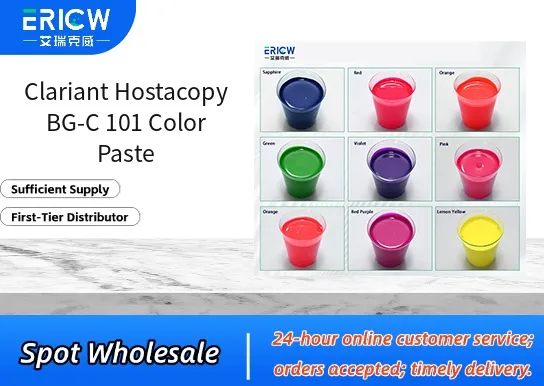
Highly concentrated pigment dispersion for efficient coloration with low dosage.
Excellent compatibility with polyolefin-based polymer systems, including PP and PE.
Good thermal stability up to 280 °C, suitable for high-temperature processing such as injection molding.
Low migration and blooming tendency, ensuring consistent color integrity in final parts.
Free from heavy metals and compliant with major global regulatory frameworks (e.g., FDA 21 CFR, EU Directive 2002/72/EC).
Coloration of polypropylene (PP) automotive interior components.
Pigmenting polyethylene (PE) packaging films and containers.
Masterbatch production for consumer goods requiring vibrant, stable black-gray shades.
Injection-molded household appliances and technical parts.
| Chemical Type | Organic pigment dispersion in polyolefin carrier |
| Product Form | Viscous paste |
| Appearance | Homogeneous black-gray paste |
| Primary Applications | Polyolefins (PP, HDPE, LDPE) |
| Key Features | High dispersion quality, low viscosity, excellent batch-to-batch consistency |
| Benefits | Reduced dusting, improved dosing accuracy, enhanced color strength |
| Recommended Dosage Range | 0.5–3.0 wt% depending on substrate and shade depth |
| Storage Conditions | Store in original sealed container at 10–30 °C; avoid freezing and direct sunlight |
Q1: What is the primary application field for Hostacopy BG-C 101?
A: Hostacopy BG-C 101 is specifically developed for coloring polyolefin-based packaging films and sheets, particularly in applications requiring high transparency, excellent dispersion, and good thermal stability during extrusion and thermoforming processes.
Q2: Is Hostacopy BG-C 101 suitable for food-contact applications?
A: Yes — Hostacopy BG-C 101 is formulated using pigments and carriers compliant with global food-contact regulations for polyolefins. It is intended for use in food packaging where regulatory approval of the final formulation is confirmed by the compounder or converter.
Q3: How should Hostacopy BG-C 101 be incorporated into polyolefin compounds?
A: It is typically added directly to the base polymer via gravimetric or volumetric dosing systems prior to extrusion. Good mixing efficiency is achieved under standard melt-processing conditions; pre-blending with a portion of the base resin may further enhance dispersion uniformity.
Q4: What are the key handling and storage recommendations?
A: Store in original sealed containers at temperatures between 5 °C and 30 °C, away from direct sunlight and moisture. Avoid freezing. Ensure containers remain tightly closed when not in use to prevent skinning or viscosity changes over time.
Contact With Us:
E-mail: wangxingqiang@ericwchem.com
Have a Questions? Call Us:
Add:
Building A1, Jiete Industrial Park, Huangpu District, Guangzhou City, Guangdong Province, China