English
 Español
 tiếng việt
 русский
Excellent soft-touch feel with balanced hardness (Shore A 25) for ergonomic design.
Outstanding adhesion to polypropylene (PP) and polyethylene (PE) without primer or surface treatment.
Good low-temperature flexibility down to –40 °C, maintaining elasticity in cold environments.
High melt flow index (MFI: 12 g/10 min @ 200 °C/5 kg) enabling efficient injection molding and thin-wall processing.
RoHS-compliant formulation with no added phthalates, heavy metals, or halogenated flame retardants.
Overmolded grips for power tools and hand-held appliances.
Soft-touch automotive interior components including trim bezels and control knobs.
Sealing rings and gasketing for consumer electronics enclosures.
Ergonomic housings for medical devices requiring tactile feedback and chemical resistance.
Flexible hinges and living hinges in packaging and disposable healthcare products.
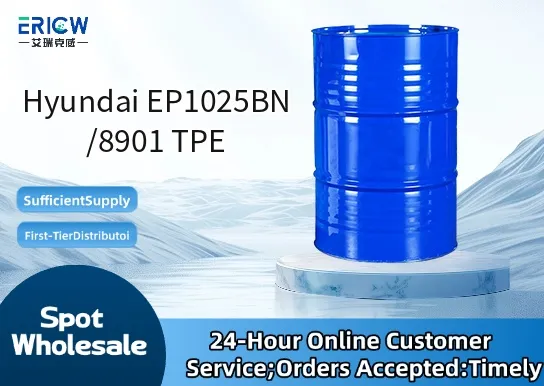
| Chemical Type | Thermoplastic Elastomer (TPE) — Styrenic Block Copolymer (SBC) based |
| Product Form | Pellets |
| Appearance | Translucent off-white granules |
| Shore Hardness (A Scale) | 25 ± 2 |
| Melt Flow Index (MFI) | 12 g/10 min (200 °C / 5 kg) |
| Density | 0.90 g/cm³ |
| Key Features | PP/PE adhesion, soft-touch, low-temperature flexibility, easy processing |
| Compliance | RoHS 2011/65/EU, REACH SVHC-free, FDA extractables tested |
Q1: What is the primary function of Hyundai EP1025BN/8901 TPE in polymer formulations?
A: Hyundai EP1025BN/8901 TPE is a thermoplastic elastomer designed to enhance flexibility, impact resistance, and melt processability in polyolefin-based compounds—commonly used as a compatibilizer or soft-phase modifier in PP/EPDM blends and similar systems.
Q2: Is EP1025BN/8901 suitable for applications requiring food contact compliance?
A: While EP1025BN/8901 is formulated without intentionally added heavy metals or known SVHCs, it is not pre-certified for food contact use. End-use compliance must be verified by the compounder through full formulation testing and regulatory review per applicable regional requirements.
Q3: How does processing temperature affect the performance of EP1025BN/8901 during extrusion or injection molding?
A: EP1025BN/8901 exhibits good thermal stability within standard TPE processing windows (typically 170–220 °C). Excessive residence time or temperatures above 230 °C may lead to partial degradation, resulting in reduced elasticity and surface quality—optimal conditions should be established via trial runs under actual production parameters.
Q4: Can EP1025BN/8901 be blended with other TPEs or thermoplastics beyond polypropylene?
A: Yes—it shows favorable compatibility with various polyolefins (e.g., HDPE, LDPE) and certain engineering thermoplastics such as PA6 and PC when appropriate compatibilization strategies are applied. Compatibility with polar resins generally benefits from tailored additive packages or functionalized grades.
Contact With Us:
E-mail: wangxingqiang@ericwchem.com
Have a Questions? Call Us:
Add:
Building A1, Jiete Industrial Park, Huangpu District, Guangzhou City, Guangdong Province, China