English
 Español
 tiếng việt
 русский
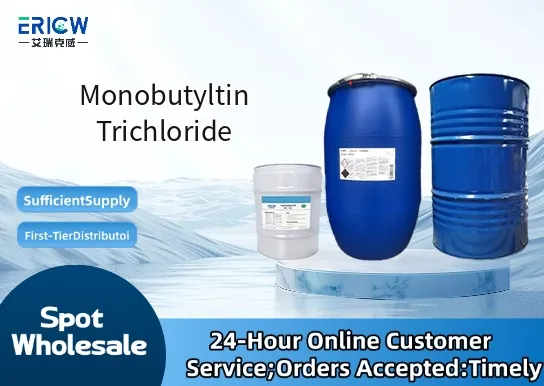
Highly effective organotin catalyst for polyurethane and silicone condensation curing systems.
Superior hydrolytic stability compared to dialkyltin derivatives, enabling longer shelf life in moisture-sensitive formulations.
Low volatility and reduced vapor pressure, enhancing operator safety during handling and processing.
Precise reactivity control—delivers consistent gel times and cure profiles across batch variations.
Compatible with a broad range of fillers, pigments, and functional silanes without adverse interaction.
Catalyst in RTV-1 (one-component) silicone sealants for construction and automotive assembly.
Crosslinking accelerator in moisture-curing polyurethane adhesives and coatings.
Stabilizer modifier in PVC processing formulations requiring low-temperature compatibility.
Intermediate in the synthesis of butyltin-based biocides and specialty agrochemicals.
Reaction promoter in esterification and transesterification processes under mild conditions.
| Chemical Type | Organotin compound (monobutyltin derivative) |
| Product Form | Liquid (clear to pale yellow) |
| Appearance | Colorless to light amber, transparent liquid |
| Melting Point | -25 °C (approx., may vary slightly with purity) |
| Boiling Point | 200–210 °C at 760 mmHg (decomposes above 220 °C) |
| Primary Applications | Catalysis in silicones, polyurethanes, and esterification reactions |
| Key Features | Low odor, controlled reactivity, hydrolysis-resistant Sn–C bond |
| Regulatory Compliance | REACH registered; not classified as CMR under CLP (as supplied); SDS available upon request |
| Common Compatible Systems | Suitability |
| Alkoxy-silane based RTV-1 formulations | Highly Recommended – Delivers rapid, deep-section cure with minimal inhibition |
| Monoisocyanate-terminated polyurethane prepolymers | Recommended – Effective catalyst at 0.05–0.2 wt% loading; requires moisture control |
| PVC plastisol systems (low-heat processing) | Suitable – Acts as secondary thermal stabilizer; limited use due to chloride content |
| Acetic acid-terminated silicone sealants | Highly Recommended – Excellent compatibility and storage stability |
Q1: What is the CAS number for Monobutyltin Trichloride?
A: The CAS Registry Number is 1118-46-3.
Q2: What is the typical recommended dosage in silicone sealants?
A: Standard loading ranges from 0.03 to 0.15 wt% relative to total formulation weight; optimal level depends on base polymer viscosity, filler loading, and desired skin-over time.
Q3: How does Monobutyltin Trichloride compare to Dibutyltin Dilaurate (DBTDL)?
A: MBTC offers lower volatility and higher hydrolytic stability than DBTDL, making it preferable for high-humidity applications and long-shelf-life products; however, it exhibits milder catalytic activity and may require slightly elevated temperatures for full cure.
Q4: Is Monobutyltin Trichloride compliant with EU RoHS or FDA regulations for food-contact applications?
A: It is not approved for direct food-contact applications under FDA 21 CFR or EU Framework Regulation (EC) No 1935/2004; final formulated products must undergo full migration testing and regulatory review before claiming compliance.
Q5: Does Monobutyltin Trichloride pose extractable tin concerns in medical device adhesives?
A: Yes—residual tin species may be extractable under physiological conditions; users must validate residual tin levels per ISO 10993-12 and implement strict process controls and post-cure leaching protocols where required.
Contact With Us:
E-mail: wangxingqiang@ericwchem.com
Have a Questions? Call Us:
Add:
Building A1, Jiete Industrial Park, Huangpu District, Guangzhou City, Guangdong Province, China