English
 Español
 tiếng việt
 русский
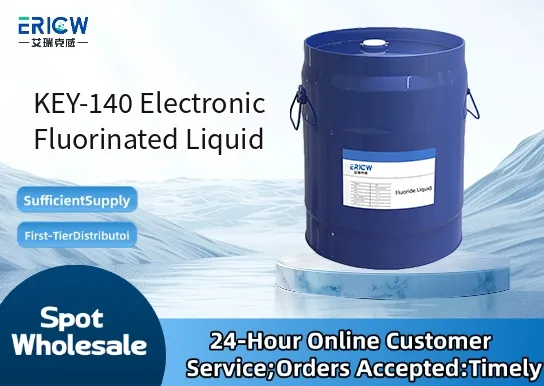
Non-conductive and electrically inert for safe use in live electronic environments.
Zero ozone depletion potential (ODP = 0) and ultra-low global warming potential (GWP < 10).
Fast-drying, residue-free evaporation with no need for rinsing or wiping.
Chemically stable across wide temperature and humidity ranges (-40 °C to +125 °C).
Non-corrosive to copper, aluminum, solder alloys, and common PCB substrates.
Precision cleaning of printed circuit boards (PCBs) prior to conformal coating.
Defluxing of fine-pitch SMT assemblies and BGA components.
Coolant and heat-transfer medium in immersion cooling systems for high-performance computing.
Dielectric testing fluid for high-voltage capacitor and transformer manufacturing.
Carrier solvent for fluoropolymer-based protective coatings in electronics assembly.
| Chemical Type | Perfluorinated polyether (PFPE), linear structure |
| Product Form | Clear, colorless liquid |
| Appearance | Transparent, odorless, non-viscous |
| Melting Point | –65 °C (typical) |
| Boiling Point (at 760 mmHg) | 112 °C (typical) |
| Density (20 °C) | 1.72 g/cm³ |
| Dielectric Strength | ≥45 kV/mm (ASTM D877) |
| Regulatory Compliance | REACH SVHC-free; RoHS 3 compliant; UL Recognized (E515977) |
| Common Compatible Systems | Suitability |
| Batch vapor degreasers (e.g., Techspray Vaportek® series) | Highly Recommended – Optimized for condensation rinse and drying cycles |
| Immersion cooling racks (e.g., Green Revolution Cooling RackHD) | Highly Recommended – Stable thermal performance up to 85 °C continuous operation |
| Ultrasonic cleaning systems (25–40 kHz) | Recommended – Effective at low concentrations; avoid prolonged cavitation >10 min |
| Automated spray-in-air cleaners (e.g., Electrovert EcoJet™) | Suitable – Requires nozzle calibration for uniform mist distribution |
Q1: What is the CAS Registry Number for KEY-140?
A: The CAS number is 13252-13-6, assigned to its primary PFPE component (Krytox® GPL-type analog structure).
Q2: What is the recommended usage concentration for defluxing applications?
A: KEY-140 is used neat (100% concentration); dilution is not recommended as it compromises dielectric integrity and volatility profile.
Q3: How does KEY-140 compare to hydrocarbon or chlorinated solvents in terms of material compatibility?
A: Unlike hydrocarbons, KEY-140 shows no swelling or stress cracking in polycarbonate or ABS; unlike chlorinated solvents, it poses no risk of metal halide formation or latent corrosion on silver-plated contacts.
Q4: Is KEY-140 subject to FDA extraction limits for electronics used in medical devices?
A: Yes — validated per USP <87> and <88> cytotoxicity testing; extractables ≤ 0.1 µg/cm² for polymeric interfaces per ISO 10993-12 protocols.
Contact With Us:
E-mail: wangxingqiang@ericwchem.com
Have a Questions? Call Us:
Add:
Building A1, Jiete Industrial Park, Huangpu District, Guangzhou City, Guangdong Province, China