English
 Español
 tiếng việt
 русский
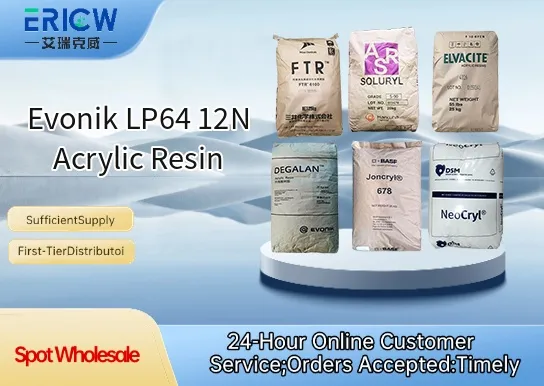
High-solids, low-viscosity acrylic resin for efficient formulation and reduced VOC content.
Excellent compatibility with nitrocellulose, CAB, and other common film-formers in solvent-based systems.
Delivers outstanding gloss retention, clarity, and UV resistance in protective and decorative coatings.
Provides balanced hardness and flexibility for durable topcoat performance on rigid substrates.
Designed for fast-drying applications with good flow and leveling characteristics.
Automotive refinish clearcoats and basecoats.
Industrial maintenance coatings for metal and plastic substrates.
Wood finishing systems requiring high-gloss, abrasion-resistant films.
General-purpose solvent-borne decorative coatings for furniture and fixtures.
Coating formulations where low-Tg acrylic performance and compatibility are critical.
| Chemical Type | Acrylic copolymer |
| Product Form | Liquid solution (solvent-borne) |
| Appearance | Clear, colorless to pale yellow liquid |
| Solvent System | Typically xylene/ester blend |
| Solids Content (wt%) | 64 ± 1% |
| Viscosity (DIN 4, 23°C) | 12–14 s |
| Acid Value (mg KOH/g) | ≤ 5 |
| Glass Transition Temperature (Tg) | Approx. 12°C (by DSC) |
Q1: What is the primary function of LP64 12N in coating formulations?
A: LP64 12N is a low-viscosity, non-ionic acrylic resin designed primarily as a rheology modifier and matting agent. It helps control flow and leveling while contributing to uniform surface texture and reduced gloss in solventborne and high-solids industrial coatings.
Q2: Is LP64 12N compatible with common crosslinkers used in thermosetting systems?
A: Yes — LP64 12N exhibits good compatibility with melamine-formaldehyde and urea-formaldehyde resins, as well as with blocked isocyanates in two-component polyurethane systems. Its non-ionic nature minimizes interference with acid-catalyzed cure mechanisms.
Q3: How should LP64 12N be incorporated into a formulation to ensure optimal performance?
A: It is recommended to add LP64 12N during the let-down stage under moderate agitation. Pre-dilution in a compatible solvent may improve dispersion. Avoid high-shear mixing post-addition to preserve its structural integrity and matte effect.
Q4: Does LP64 12N affect film hardness or drying behavior?
A: LP64 12N is non-film-forming and remains largely inert in the cured matrix. It does not significantly alter through-dry time or final hardness when used within typical dosage ranges, though excessive loading may slightly reduce crosslink density.
Contact With Us:
E-mail: wangxingqiang@ericwchem.com
Have a Questions? Call Us:
Add:
Building A1, Jiete Industrial Park, Huangpu District, Guangzhou City, Guangdong Province, China