English
 Español
 tiếng việt
 русский
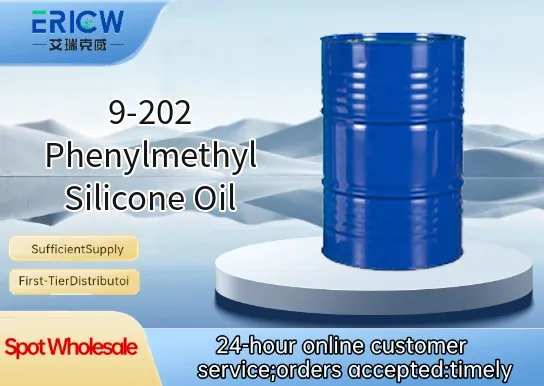
Excellent thermal stability up to 250 °C in inert atmospheres.
Superior resistance to UV radiation and oxidative degradation.
Low volatility with negligible weight loss under prolonged heating.
Good compatibility with organic resins, silicones, and common industrial solvents.
Non-yellowing performance ideal for optical and high-clarity applications.
High-temperature heat transfer fluids in semiconductor manufacturing equipment.
Base fluid for specialty lubricants used in precision instrumentation and vacuum systems.
Release agent for silicone rubber molding and high-heat composite processing.
Formulation component in optical coatings and anti-fogging additives for lenses.
Dielectric fluid in high-voltage capacitors requiring long-term thermal reliability.
| Chemical Type | Phenylmethyl polysiloxane |
| Product Form | Clear, colorless to pale yellow liquid |
| Appearance | Homogeneous, transparent, free of sediment or haze |
| Viscosity (25 °C, cSt) | 200 ± 20 |
| Density (25 °C, g/cm³) | 1.02–1.06 |
| Refractive Index (25 °C) | 1.485–1.495 |
| Flash Point (COC, °C) | ≥300 |
| Volatility (200 °C, 24 h, wt%) | ≤1.5 |
Q1: What distinguishes 9-202 Phenylmethyl Silicone Oil from standard dimethyl silicone oils?
A: The phenyl groups in its backbone significantly enhance thermal stability, UV resistance, and compatibility with aromatic solvents and polymers—making it especially suitable for high-performance coatings, optical adhesives, and specialty elastomers where conventional dimethyl silicones may degrade or phase-separate.
Q2: Is 9-202 compatible with common industrial resins such as epoxy, polyurethane, and acrylic systems?
A: Yes—it demonstrates broad compatibility with epoxy, polyurethane, and acrylic resin matrices, often improving flow, leveling, and surface defect suppression without compromising cure kinetics or final film integrity. Compatibility testing under actual processing conditions is recommended due to formulation-specific interactions.
Q3: How should 9-202 be incorporated into a formulation to ensure optimal performance?
A: It is typically added during the late-stage mixing phase under moderate shear and ambient to mildly elevated temperatures. Due to its low surface tension and high compatibility, it disperses readily without requiring high-shear homogenization—though extended agitation may be needed in highly viscous or filled systems to achieve uniform distribution.
Q4: Can 9-202 be used in applications requiring food-contact compliance or pharmaceutical-grade processing?
A: 9-202 is not pre-qualified for direct food-contact or pharmaceutical use. While phenylmethyl silicones are widely employed in industrial lubrication and release applications, regulatory clearance must be obtained separately based on the specific end-use, processing conditions, and applicable jurisdictional requirements.
Contact With Us:
E-mail: wangxingqiang@ericwchem.com
Have a Questions? Call Us:
Add:
Building A1, Jiete Industrial Park, Huangpu District, Guangzhou City, Guangdong Province, China