English
 Español
 tiếng việt
 русский
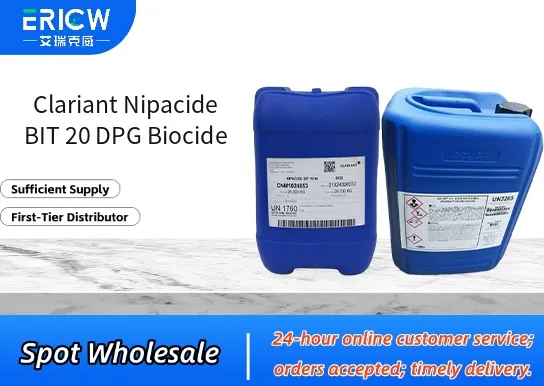
Highly effective broad-spectrum biocide against bacteria, fungi, and algae.
Stable in water-based systems across a wide pH range (pH 2–12).
Low volatility and low odor profile, enhancing workplace safety and handling convenience.
Compatible with common surfactants, thickeners, and other formulation ingredients.
Non-oxidizing mode of action, minimizing corrosion risk in metal-containing systems.
Latex paints and architectural coatings.
Industrial maintenance coatings and coil coatings.
Water-based adhesives and sealants.
Construction chemicals including grouts, mortars, and cementitious slurries.
Printing inks and pigment dispersions.
| Chemical Type | 1,2-Benzisothiazolin-3-one (BIT) in dipropylene glycol (DPG) solution |
| Product Form | Liquid |
| Appearance | Clear, colorless to pale yellow liquid |
| Active Content | 20.0 ± 1.0 wt% BIT |
| Density (20 °C) | 1.05–1.09 g/cm³ |
| pH (1% aqueous solution) | 6.0–8.0 |
| Solubility | Miscible with water and common organic solvents |
| Storage Stability | ≥24 months at 5–25 °C in original sealed container |
Q1: What is the primary active ingredient in Nipacide BIT 20 DPG Biocide?
A: The active biocidal component is 1,2-benzisothiazolin-3-one (BIT), formulated as a 20% aqueous solution in dipropylene glycol (DPG) to enhance stability and compatibility in water-based systems.
Q2: In which types of industrial formulations is this biocide commonly used?
A: It is widely applied in water-based coatings, adhesives, sealants, construction chemicals, metalworking fluids, and cleaning concentrates—particularly where broad-spectrum protection against bacteria and fungi is required during storage and in-use conditions.
Q3: How does the DPG solvent affect formulation performance?
A: Dipropylene glycol improves solubility and stabilization of BIT in polar systems, reduces volatility compared to lower-glycol carriers, and contributes to favorable compatibility with many polymers and surfactants—minimizing risks of phase separation or haze formation.
Q4: Is Nipacide BIT 20 DPG suitable for use in low-pH systems?
A: Yes, it demonstrates good hydrolytic stability across a broad pH range (typically pH 2–12), making it suitable for acidic formulations such as certain cleaners, etchants, and pigment dispersions where other isothiazolones may degrade more rapidly.
Q5: What safety and handling considerations apply to this product?
A: As with all biocides, appropriate personal protective equipment (PPE) including gloves and eye protection should be worn during handling. It is classified as a skin and eye irritant; users must consult the Safety Data Sheet (SDS) for detailed toxicological information, first-aid measures, and safe storage guidance.
Contact With Us:
E-mail: wangxingqiang@ericwchem.com
Have a Questions? Call Us:
Add:
Building A1, Jiete Industrial Park, Huangpu District, Guangzhou City, Guangdong Province, China