English
 Español
 tiếng việt
 русский
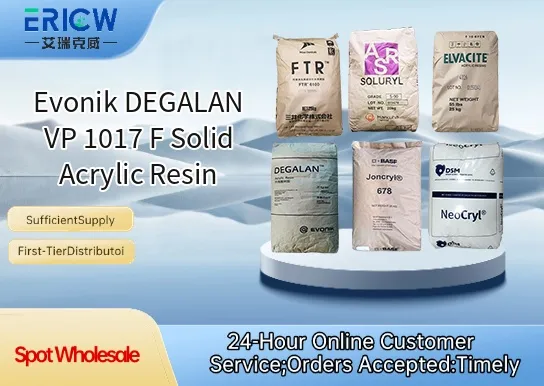
High molecular weight solid acrylic resin offering excellent film hardness and scratch resistance.
Designed for solvent-borne systems with good solubility in common organic solvents including esters, ketones, and aromatic hydrocarbons.
Provides outstanding gloss retention and UV stability in demanding outdoor coatings applications.
Enables formulation of high-solids, low-VOC coatings without compromising flow, leveling, or mechanical performance.
Consistent batch-to-batch quality supported by Evonik’s stringent GMP-aligned manufacturing control.
Automotive OEM and refinish clearcoats requiring high gloss and mar resistance.
Industrial maintenance coatings for metal substrates exposed to harsh environmental conditions.
Architectural high-performance façade coatings and aluminum composite panel (ACP) finishes.
Powder coating modifiers and hybrid binder components for enhanced surface aesthetics.
| Chemical Type | Solid acrylic copolymer |
| Product Form | Free-flowing white to off-white granules |
| Appearance | Homogeneous granular solid |
| Glass Transition Temperature (Tg) | ~105 °C (DSC, 10 °C/min) |
| Solubility | Readily soluble in xylene, butyl acetate, MEK, and MIBK |
| Volatile Organic Content (VOC) | < 1 % (by weight) |
| Key Features | High hardness, UV resistance, thermal stability, compatibility with melamine and polyisocyanate crosslinkers |
| Primary Applications | High-performance solvent-borne clearcoats, industrial protective coatings, architectural premium finishes |
Q1: What is the primary function of DEGALAN VP 1017 F in coating formulations?
A: DEGALAN VP 1017 F is a solid acrylic resin designed primarily as a rheology modifier and matting agent in solvent-borne and high-solids industrial coatings. It helps control flow, enhance sag resistance, and deliver consistent, low-gloss surface appearance without compromising film integrity.
Q2: Is DEGALAN VP 1017 F compatible with common crosslinkers used in thermosetting systems?
A: Yes — it is formulated to be compatible with standard amino resins (e.g., melamine-formaldehyde) and isocyanate-based crosslinkers in baking and ambient-cure systems. Compatibility should always be verified experimentally within the specific formulation matrix due to variations in solvent blends and resin chemistry.
Q3: How is DEGALAN VP 1017 F typically incorporated into a coating formulation?
A: It is generally added during the let-down or post-additive stage, dispersed using high-shear mixing. Pre-wetting with compatible solvents or resins prior to incorporation improves dispersion efficiency and minimizes agglomeration. Avoid prolonged high-temperature milling, as thermal exposure may affect particle morphology and performance.
Q4: Does DEGALAN VP 1017 F require stabilization against sedimentation in storage?
A: While inherently more stable than many liquid matting agents, formulations containing DEGALAN VP 1017 F may benefit from conventional anti-settling additives—such as fumed silica or associative thickeners—especially in low-viscosity or long-term storage applications. Good formulation practice includes evaluating storage stability under representative temperature and time conditions.
Contact With Us:
E-mail: wangxingqiang@ericwchem.com
Have a Questions? Call Us:
Add:
Building A1, Jiete Industrial Park, Huangpu District, Guangzhou City, Guangdong Province, China