English
 Español
 tiếng việt
 русский
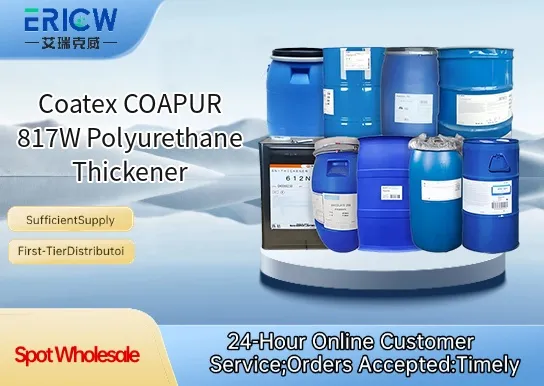
Non-ionic, hydrophobically modified polyurethane (HEUR) rheology modifier for waterborne systems.
Delivers excellent mid-shear viscosity control and outstanding sag resistance in architectural and industrial coatings.
Provides good compatibility with a broad range of latex polymers, pigments, and common formulation additives.
Enables low foaming performance and high storage stability without compromising gloss or leveling.
Offers efficient thickening at low dosage levels, supporting cost-effective and sustainable formulations.
Architectural interior and exterior flat to semi-gloss acrylic and vinyl-acrylic emulsion paints.
Industrial maintenance coatings including primers, topcoats, and anti-corrosive systems.
Wood coatings such as waterborne varnishes and stains requiring balanced flow and anti-drip performance.
Waterborne adhesives and sealants where controlled rheology and open time are critical.
| Chemical Type | Hydrophobically Modified Polyurethane (HEUR) |
| Product Form | Liquid |
| Appearance | Opaque white to off-white viscous liquid |
| pH (1% aqueous solution) | 6.5 – 8.0 |
| Active Content | 30.0 ± 1.0 wt% |
| Viscosity (Brookfield RVT, spindle #3, 20 rpm, 25°C) | 8,000 – 15,000 mPa·s |
| Solubility / Miscibility | Readily dispersible in water; compatible with most common co-solvents |
| Primary Applications | Waterborne architectural and industrial coatings, wood finishes, adhesives |
Q1: What type of rheology does COAPUR 817W provide in waterborne systems?
A: COAPUR 817W is a hydrophobically modified polyurethane (HEUR) thickener that delivers strong pseudoplastic (shear-thinning) behavior, providing excellent sag resistance at rest while enabling good flow and leveling during application.
Q2: Is COAPUR 817W compatible with high-shear processes and common paint additives?
A: Yes — COAPUR 817W exhibits good stability under moderate to high shear conditions and is generally compatible with standard anionic and nonionic surfactants, defoamers, biocides, and co-thickeners such as associative cellulose ethers, though compatibility testing in the final formulation is recommended.
Q3: How should COAPUR 817W be incorporated into a waterborne formulation?
A: It is typically added during the let-down stage, either neat or pre-diluted with water or a water-miscible solvent. Slow, controlled addition with moderate agitation helps ensure uniform dispersion and optimal thickening performance without air entrapment.
Q4: Does COAPUR 817W contribute to film formation or affect dry-film properties?
A: As a non-film-forming rheology modifier, COAPUR 817W remains in the aqueous phase and does not coalesce into the polymer film. It therefore has minimal impact on final film integrity, gloss, or adhesion when used at typical dosage levels.
Contact With Us:
E-mail: wangxingqiang@ericwchem.com
Have a Questions? Call Us:
Add:
Building A1, Jiete Industrial Park, Huangpu District, Guangzhou City, Guangdong Province, China