English
 Español
 tiếng việt
 русский
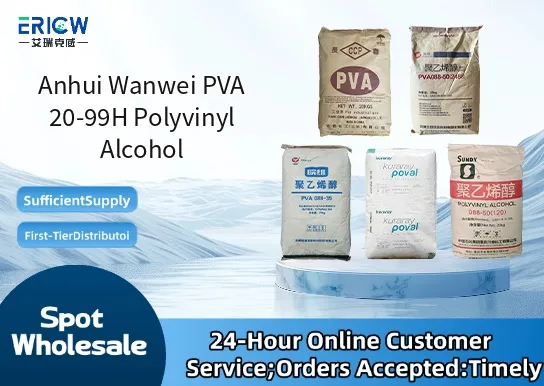
High degree of hydrolysis (≥99.0%) ensuring excellent water solubility and film-forming capability.
Consistent molecular weight distribution for reliable viscosity control in aqueous solutions.
Low residual acetate content (<0.5%), enhancing chemical stability and reducing odor.
Free-flowing white granular form with uniform particle size, facilitating easy handling and dissolution.
Complies with GB/T 12010.1–2018 and meets ISO 9001 manufacturing standards.
Textile sizing agent for warp yarns in high-speed weaving processes.
Binder in ceramic green body formation and refractory tile production.
Emulsifier and protective colloid in vinyl acetate-based emulsion polymerization.
Adhesive component for paper lamination, corrugated board, and specialty labels.
Thickener and film former in water-based coatings and pigment dispersions.
| Chemical Type | Polyvinyl alcohol (fully hydrolyzed) |
| Product Form | White granules |
| Appearance | Free-flowing, odorless white granules |
| Hydrolysis Degree | ≥99.0 mol% |
| Viscosity (4% aq., 20°C) | 20–22 mPa·s |
| Residual Acetate Content | ≤0.5 wt% |
| pH (5% solution) | 5.5–7.0 |
| Volatiles (105°C, 2h) | ≤5.0 wt% |
Q1: What does the designation “20-99H” indicate for this PVA grade?
A: The “20” refers to an approximate average degree of polymerization (~2000), indicating molecular weight in the medium range; “99” denotes a saponification degree of approximately 99%, meaning very high hydrolysis and excellent water solubility with minimal residual acetate groups; “H” signifies a high-viscosity variant suitable for applications requiring enhanced film-forming and binding performance.
Q2: How should Anhui Wanwei PVA 20-99H be dissolved for optimal performance in aqueous systems?
A: For efficient dissolution, gradually disperse the powder into cold water under vigorous agitation to prevent agglomeration, then heat the mixture to 85–95 °C while maintaining stirring until fully transparent. Avoid direct addition to boiling water, as surface gelation may hinder complete hydration.
Q3: Is this PVA grade suitable for use in water-soluble packaging films?
A: Yes — its high saponification level and balanced molecular weight make it well-suited for water-soluble films, offering good tensile strength, clarity, and controlled dissolution rates in ambient or warm water, depending on film thickness and formulation additives.
Q4: Can PVA 20-99H be used as a binder in ceramic or refractory green bodies?
A: Yes — it functions effectively as a temporary organic binder in ceramic and refractory processing, providing green strength during shaping and drying, and cleanly burning out at low temperatures without ash residue, supporting high-purity final products.
Contact With Us:
E-mail: wangxingqiang@ericwchem.com
Have a Questions? Call Us:
Add:
Building A1, Jiete Industrial Park, Huangpu District, Guangzhou City, Guangdong Province, China