English
 Español
 tiếng việt
 русский
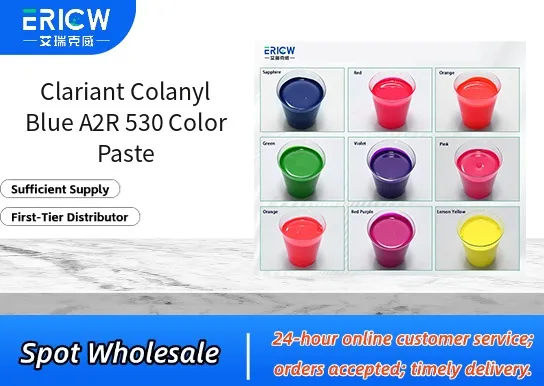
High chroma, clean phthalocyanine blue shade with excellent lightfastness and weather resistance.
Optimized for low-viscosity systems—provides exceptional dispersion stability in water-based and solvent-based formulations.
Low heavy metal content, compliant with global regulatory requirements including EU REACH and US CPSIA.
Excellent heat stability up to 180 °C, suitable for demanding processing conditions.
Consistent batch-to-batch color reproducibility supported by Clariant’s stringent quality control protocols.
Architectural coatings—including interior/exterior wall paints and decorative plasters.
Industrial maintenance coatings for metal and concrete substrates.
Water-based wood stains and clear finishes requiring high transparency and color clarity.
Plastic masterbatches for polyolefins and PVC applications.
Printing inks for flexible packaging and label printing (solvent and water-based).
| Chemical Type | Copper phthalocyanine pigment dispersion |
| Product Form | Liquid color paste (aqueous/solvent hybrid vehicle) |
| Appearance | Viscous, homogeneous blue paste |
| Primary Applications | Coatings, inks, plastics |
| Key Features | High tinctorial strength, low foaming, non-settling |
| Benefits | Reduced dosage, simplified formulation, improved gloss retention |
| VOC Content | Low-VOC (< 50 g/L, as supplied) |
| Storage Stability | 12 months at 5–30 °C in sealed original container |
Q1: What types of polymer systems is Colanyl Blue A2R 530 compatible with?
A: Colanyl Blue A2R 530 is specifically formulated for use in polyolefins—including PP and HDPE—as well as certain engineering thermoplastics. It demonstrates good thermal stability during standard extrusion and injection molding processes and shows minimal plate-out in typical processing conditions.
Q2: Is this color paste suitable for food-contact applications?
A: Colanyl Blue A2R 530 is designed to meet general requirements for food-contact plastics under widely recognized regulatory frameworks. Its suitability for a specific food-contact application depends on the final formulation, processing conditions, and applicable regional regulations—end users must conduct appropriate compliance verification.
Q3: How should Colanyl Blue A2R 530 be incorporated into base resins?
A: This paste is typically introduced via gravimetric or volumetric dosing directly into the extruder throat or hopper, often using side-feeders. Pre-blending with carrier resin is not required, but thorough mixing at the point of addition ensures optimal dispersion and color uniformity.
Q4: Does this product offer resistance to migration and blooming?
A: Yes—Colanyl Blue A2R 530 exhibits low tendency toward migration and blooming in properly formulated polyolefin systems, especially when processed within recommended temperature ranges and stabilized with appropriate antioxidant packages.
Contact With Us:
E-mail: wangxingqiang@ericwchem.com
Have a Questions? Call Us:
Add:
Building A1, Jiete Industrial Park, Huangpu District, Guangzhou City, Guangdong Province, China