English
 Español
 tiếng việt
 русский
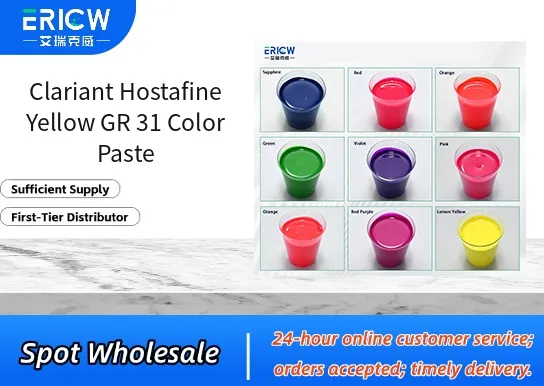
High chroma yellow shade with excellent lightfastness and weather resistance.
Optimized for compatibility with a broad range of water-based and solvent-based systems.
Consistent batch-to-batch color reproducibility and rheological stability.
Low volatile organic compound (VOC) content, supporting sustainable formulation goals.
Easy dispersion with minimal grinding required, enhancing production efficiency.
Architectural and industrial waterborne coatings.
Automotive refinish and OEM basecoat systems.
Plastic masterbatches for polyolefins and engineering resins.
Printing inks for flexible packaging and paper applications.
Wood stains and decorative surface finishes.
| Chemical Type | Azo pigment dispersion |
| Product Form | Liquid color paste |
| Appearance | Homogeneous, viscous yellow paste |
| Primary Applications | Coatings, plastics, inks |
| Key Features | High transparency, good heat stability up to 200°C |
| Benefits | Reduced formulation complexity, improved color strength |
| Base Solvent | Water and glycol ether blend |
| Typical Solid Content | 35–40 wt% |
Q1: What is the primary application field for Hostafine Yellow GR 31 Color Paste?
A: Hostafine Yellow GR 31 is primarily formulated for use in solvent-based and water-based industrial coatings, including automotive refinish, general industrial finishes, and coil coatings—where high chroma, good lightfastness, and compatibility with common resin systems are required.
Q2: Is this color paste suitable for food-contact coatings?
A: Hostafine Yellow GR 31 is not specifically designed or certified for food-contact applications. Its use in such systems requires full regulatory assessment by the formulator, including compliance verification against applicable regional food contact legislation and migration testing under intended conditions.
Q3: How should this paste be dispersed in a coating formulation?
A: For optimal performance, Hostafine Yellow GR 31 should be incorporated during the let-down stage using standard high-shear mixing equipment. Pre-dilution with a compatible solvent or vehicle may improve dispersion efficiency, especially in low-viscosity systems.
Q4: What are the recommended storage conditions?
A: Store in original sealed containers at temperatures between 5 °C and 30 °C, away from direct sunlight and sources of heat or freezing. Prolonged exposure to extreme temperatures or humidity may affect viscosity and stability.
Contact With Us:
E-mail: wangxingqiang@ericwchem.com
Have a Questions? Call Us:
Add:
Building A1, Jiete Industrial Park, Huangpu District, Guangzhou City, Guangdong Province, China