English
 Español
 tiếng việt
 русский
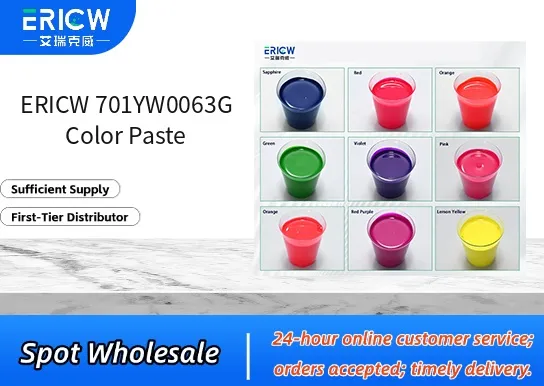
High chroma yellow pigment dispersion with excellent color strength and consistency.
Optimized for compatibility with water-based acrylic, polyurethane, and alkyd resin systems.
Low volatile organic compound (VOC) content, supporting eco-friendly formulation requirements.
Stable rheology and long-term storage stability without sedimentation or separation.
Good lightfastness and thermal stability up to 180 °C for demanding processing conditions.
Architectural and industrial waterborne coatings.
Automotive refinish basecoats and clearcoat tints.
Plastic masterbatch for ABS, PP, and PS substrates.
Wood stains and decorative finishes for furniture and flooring.
Inkjet ink formulations requiring high-resolution yellow hue fidelity.
| Chemical Type | Organic pigment dispersion (Azo-type yellow) |
| Product Form | Liquid color paste |
| Appearance | Homogeneous viscous liquid, bright yellow shade |
| Primary Applications | Water-based and solvent-borne coatings, plastics, inks |
| Key Features | High tinting strength, low viscosity, non-settling |
| Benefits | Reduced formulation time, improved batch-to-batch reproducibility |
| pH (25 °C) | 7.2–7.8 |
| Storage Stability | ≥12 months at 5–30 °C, unopened container |
Q1: What is the primary application of ERICW 701YW0063G Color Paste?
A: ERICW 701YW0063G is a high-performance yellow color paste formulated for use in thermoplastic polymers, especially polyolefins (e.g., PP and PE), engineering plastics, and masterbatch systems where consistent chroma, thermal stability, and dispersion efficiency are required.
Q2: Is this color paste suitable for food-contact or medical-grade applications?
A: ERICW 701YW0063G is designed to meet general industrial performance requirements. For food-contact or medical applications, final regulatory compliance must be verified by the compounder or end-user based on full formulation testing and applicable regional regulations — the paste itself is not pre-certified for such uses.
Q3: How should ERICW 701YW0063G be incorporated into polymer systems?
A: It is typically added via gravimetric or volumetric dosing during compounding or extrusion. Good mechanical mixing and adequate melt residence time ensure optimal dispersion. Pre-dilution in carrier resin may be beneficial for high-viscosity or sensitive formulations.
Q4: What is the recommended dosage range for achieving target color strength?
A: Dosage depends on the base polymer, desired shade intensity, and processing conditions. It is generally used at low concentrations — typically ranging from 0.1% to 2% by weight — with optimization advised through lab-scale trials.
Q5: Does ERICW 701YW0063G exhibit good thermal stability during standard polymer processing?
A: Yes — it is engineered for stability under typical polyolefin processing temperatures (up to approximately 240 °C). Performance may vary depending on residence time, shear history, and ambient atmosphere; therefore, validation under actual process conditions is recommended.
Contact With Us:
E-mail: wangxingqiang@ericwchem.com
Have a Questions? Call Us:
Add:
Building A1, Jiete Industrial Park, Huangpu District, Guangzhou City, Guangdong Province, China