English
 Español
 tiếng việt
 русский
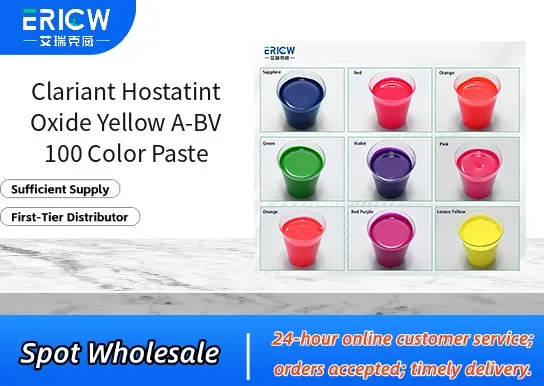
Highly concentrated iron oxide-based yellow pigment dispersion for efficient coloration.
Excellent lightfastness and weather resistance suitable for demanding outdoor applications.
Optimized rheology for easy incorporation into water-based and solvent-based systems.
Consistent batch-to-batch color strength and hue stability.
Low volatile organic compound (VOC) content, supporting sustainable formulation goals.
Architectural coatings including exterior masonry paints and stucco finishes.
Industrial maintenance coatings for infrastructure and metal protection.
Concrete and cementitious products such as colored paving slabs and precast elements.
Plaster and render systems requiring durable, alkali-stable yellow coloration.
Tile grouts and joint fillers where UV and chemical resistance are critical.
| Chemical Type | Iron oxide yellow pigment dispersion |
| Product Form | Liquid color paste |
| Appearance | Homogeneous, viscous yellow paste |
| Primary Applications | Water-based and solvent-based architectural & industrial coatings; cementitious materials |
| Key Features | Alkali stable, non-bleeding, low dusting |
| Benefits | Reduced dosage requirement, improved tinting strength, enhanced durability |
| Compatible Media | Acrylic, styrene-acrylic, PVA, silicate, and cement-based systems |
| Storage Conditions | Store at 5–30 °C; protect from freezing and direct sunlight |
Q1: What is the primary application field for Hostatint Oxide Yellow A-BV 100?
A: This pigment paste is specifically developed for coloring polyolefin compounds—especially PP and PE—in applications requiring high thermal stability, good dispersion, and resistance to blooming during processing and end-use.
Q2: Is this product suitable for food-contact plastics?
A: Hostatint Oxide Yellow A-BV 100 is formulated with inorganic iron oxide pigments and is commonly used in food-contact compliant masterbatches when incorporated at appropriate levels and processed under validated conditions; however, final regulatory compliance depends on the full formulation, processing parameters, and applicable regional requirements.
Q3: How should this paste be dispersed in polyolefin melts?
A: Optimal dispersion is achieved using standard compounding equipment such as twin-screw extruders; pre-mixing with carrier resin prior to extrusion is recommended to ensure uniform distribution and minimize agglomeration.
Q4: Does this color paste contain heavy metals or restricted substances?
A: The paste is based on synthetic iron oxide yellow pigment and does not contain lead, cadmium, mercury, or hexavalent chromium; it is manufactured in accordance with Clariant’s Responsible Care principles and relevant industry stewardship guidelines.
Contact With Us:
E-mail: wangxingqiang@ericwchem.com
Have a Questions? Call Us:
Add:
Building A1, Jiete Industrial Park, Huangpu District, Guangzhou City, Guangdong Province, China