English
 Español
 tiếng việt
 русский
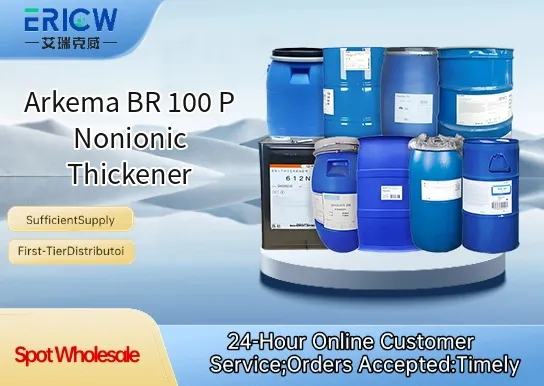
High-performance rheology modifier delivering excellent viscosity build and shear-thinning behavior in aqueous systems.
Nonionic nature ensures compatibility with anionic, cationic, and zwitterionic surfactants without destabilization.
Provides outstanding sag resistance and anti-settling performance in pigment-rich formulations.
Enables easy incorporation and rapid hydration without requiring high-shear mixing or pH adjustment.
Offers good freeze-thaw stability and long-term storage stability in water-based coatings and construction products.
Architectural interior and exterior latex paints.
Water-based industrial maintenance coatings.
Cementitious tile adhesives and grouts.
Exterior insulation finishing systems (EIFS) basecoats and finish coats.
Water-based sealers and primers for masonry and wood substrates.
| Chemical Type | Nonionic associative polyurethane thickener |
| Product Form | Liquid dispersion |
| Appearance | Opaque white to off-white liquid |
| pH (1% aqueous solution) | 6.5 – 7.5 |
| Solids Content (wt%) | 30.0 ± 1.0% |
| Viscosity (Brookfield RVT, Spindle #3, 20 rpm, 25°C) | 2,000 – 6,000 mPa·s |
| Primary Applications | Water-based architectural coatings, cementitious building materials |
| Key Features | Nonionic, low-VOC, easy-to-use, high efficiency at low dosage |
Q1: What is the primary function of BR 100 P in formulations?
A: BR 100 P is a nonionic associative thickener designed to provide efficient rheology modification—particularly enhancing mid-to-high shear viscosity and improving sag resistance—without significantly increasing low-shear viscosity or compromising flow and leveling.
Q2: Is BR 100 P compatible with ionic surfactants and other common formulation ingredients?
A: Yes, as a nonionic polymer, BR 100 P exhibits broad compatibility with anionic, cationic, and amphoteric surfactants, as well as common co-thickeners, biocides, and pH adjusters typically used in waterborne systems.
Q3: How should BR 100 P be incorporated into a formulation?
A: It is recommended to pre-dilute BR 100 P in water or a water/glycol blend prior to addition, followed by gradual incorporation under moderate agitation. Direct addition of the undiluted product is not advised to avoid localized gel formation and ensure uniform dispersion.
Q4: Does BR 100 P require pH adjustment for optimal performance?
A: Unlike many ionic thickeners, BR 100 P functions effectively across a wide pH range (approximately 4–12) and does not rely on pH-dependent ionization—making it particularly suitable for pH-sensitive or buffered systems.
Q5: In which types of end-use applications is BR 100 P most commonly employed?
A: BR 100 P is widely used in architectural coatings, industrial maintenance paints, adhesives, sealants, and cleaning formulations where balanced viscosity control, good film formation, and compatibility with diverse additives are required.
Contact With Us:
E-mail: wangxingqiang@ericwchem.com
Have a Questions? Call Us:
Add:
Building A1, Jiete Industrial Park, Huangpu District, Guangzhou City, Guangdong Province, China