English
 Español
 tiếng việt
 русский
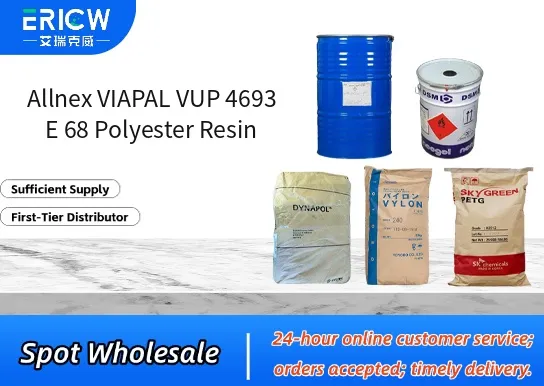
High-solids, low-VOC unsaturated polyester resin designed for energy-efficient UV-curable coatings.
Excellent reactivity under UV/LED curing systems, enabling rapid through-cure and high production throughput.
Superior hardness and scratch resistance in final cured films without compromising flexibility.
Good compatibility with common photoinitiators and reactive diluents used in industrial UV formulations.
Consistent batch-to-batch performance and long shelf stability under recommended storage conditions.
UV-curable clearcoats for wood furniture and cabinetry.
Industrial metal coatings requiring high gloss and chemical resistance.
Plastic substrates including ABS and polycarbonate for automotive interior trim.
Overprint varnishes for flexible packaging and premium printed materials.
Roll-to-roll coated films for decorative laminates and signage applications.
| Chemical Type | Unsaturated polyester resin (UV-curable) |
| Product Form | Liquid |
| Appearance | Clear, pale yellow liquid |
| Viscosity (25°C, mPa·s) | 1,200–1,800 |
| Solids Content (% w/w) | ≈68 |
| Density (25°C, g/cm³) | 1.08–1.12 |
| Primary Applications | UV-curable clearcoats, overprint varnishes, plastic & metal coatings |
| Key Features | High reactivity, excellent film hardness, low VOC, good substrate adhesion |
Q1: What is the primary application of VIAPAL VUP 4693 E 68?
A: VIAPAL VUP 4693 E 68 is a low-viscosity, high-solids unsaturated polyester resin designed primarily for high-performance UV-curable coatings and inks, especially where excellent surface hardness, gloss retention, and chemical resistance are required.
Q2: Is this resin compatible with common photoinitiator systems?
A: Yes, VIAPAL VUP 4693 E 68 demonstrates good reactivity with standard free-radical photoinitiators, including benzophenone-, alpha-hydroxyketone-, and acylphosphine oxide–based types. Compatibility and cure speed should be verified under actual lamp output and formulation conditions.
Q3: How does VIAPAL VUP 4693 E 68 perform in terms of flexibility versus hardness balance?
A: This resin delivers a favorable balance—offering high crosslink density for superior hardness and scratch resistance while maintaining sufficient backbone mobility to avoid excessive brittleness in thin-film applications.
Q4: Can it be blended with other resins or monomers?
A: Yes, VIAPAL VUP 4693 E 68 is formulated for compatibility with common reactive diluents (e.g., mono- and difunctional acrylates) and can be co-formulated with other UV-curable resins such as epoxy acrylates or aliphatic urethane acrylates to tailor film properties.
Q5: What storage conditions are recommended to maintain stability?
A: Store in tightly sealed containers at temperatures between 10 °C and 30 °C, away from direct sunlight and strong UV sources. Prolonged exposure to elevated temperatures or ambient UV radiation may lead to premature viscosity increase or gelation.
Contact With Us:
E-mail: wangxingqiang@ericwchem.com
Have a Questions? Call Us:
Add:
Building A1, Jiete Industrial Park, Huangpu District, Guangzhou City, Guangdong Province, China