English
 Español
 tiếng việt
 русский
High thermal stability suitable for processing temperatures up to 700°C.
Excellent lightfastness and weather resistance, maintaining color integrity under UV exposure.
Non-toxic and heavy-metal-free formulation compliant with global regulatory standards including EN 71-3 and RoHS.
Superior dispersion performance in aqueous and solvent-based systems without requiring additional dispersants.
Consistent batch-to-batch color reproducibility ensured by stringent ISO 9001-certified manufacturing control.
Ceramic glazes and frits for tableware and architectural tiles.
High-performance coatings for industrial equipment and exterior building façades.
Coloration of refractory materials including firebricks and kiln furniture.
Pigmentation of glass enamels and low-melting-point specialty glasses.
Additive in thermoset plastics for automotive under-hood components requiring heat resistance.
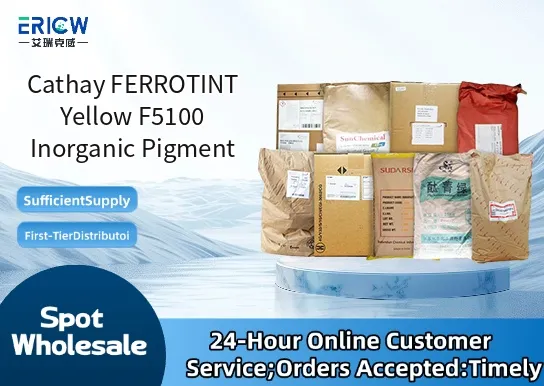
| Chemical Type | Complex iron oxide-based inorganic pigment (Fe₂O₃–ZnO–SiO₂ system) |
| Product Form | Fine dry powder |
| Appearance | Free-flowing yellow-orange powder with uniform particle distribution |
| Primary Applications | Ceramics, glass, refractories, high-temperature coatings, engineering plastics |
| Key Features | Heat stable, non-volatile, chemically inert, pH-stable (pH 4–11) |
| Benefits | No blooming or migration; retains opacity and chroma after firing or extrusion |
| Storage Conditions | Store in cool, dry, well-ventilated area away from direct sunlight and moisture |
| Regulatory Compliance | Compliant with REACH, FDA 21 CFR 178.3290 (indirect food contact), and AP(89)1 |
Q1: What is the primary chemical composition of Cathay FERROTINT Yellow F5100?
A: Cathay FERROTINT Yellow F5100 is an inorganic iron oxide-based yellow pigment, primarily composed of hydrated iron(III) oxide (Fe₂O₃·nH₂O), formulated to deliver high chroma, thermal stability, and lightfastness typical of premium-grade synthetic iron oxides.
Q2: Is this pigment suitable for use in food-contact plastics or coatings?
A: Cathay FERROTINT Yellow F5100 is not certified for direct food-contact applications. It is intended for industrial and decorative uses where regulatory compliance with food safety standards is not required. For food-contact systems, please consult our dedicated food-grade pigment portfolio and verify suitability with your regulatory team.
Q3: How does F5100 perform under elevated temperature conditions, such as during polymer processing?
A: This pigment exhibits excellent thermal stability and retains its color integrity up to approximately 300°C, making it suitable for standard thermoplastic processing methods including extrusion and injection molding — provided residence time and shear conditions remain within typical industrial parameters.
Q4: What dispersion methods are recommended for optimal color development in solvent-based coatings?
A: For solvent-based systems, pre-wetting with compatible solvents followed by high-shear dispersion using rotor-stator mixers or bead mills is recommended. The pigment responds well to conventional organic dispersants and typically achieves full development within standard milling cycles without excessive energy input.
Contact With Us:
E-mail: wangxingqiang@ericwchem.com
Have a Questions? Call Us:
Add:
Building A1, Jiete Industrial Park, Huangpu District, Guangzhou City, Guangdong Province, China