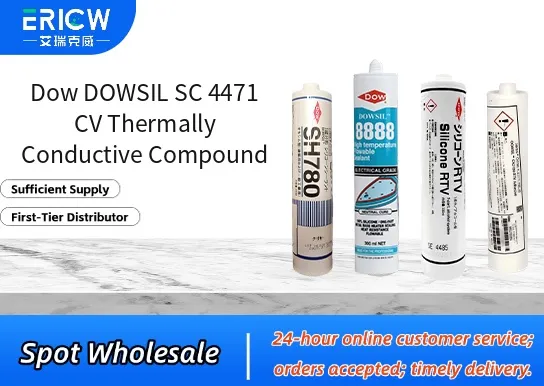
Features Of Dow DOWSIL SC 4471 CV Thermally Conductive Compound
High thermal conductivity (1.5 W/m·K) for efficient heat dissipation in demanding electronic assemblies.
Low modulus silicone formulation enables stress relief and accommodates coefficient of thermal expansion (CTE) mismatches.
Room-temperature curing with optional heat acceleration, supporting flexible manufacturing integration.
Non-corrosive and halogen-free, compliant with RoHS and REACH requirements for electronics reliability.
Controlled viscosity and thixotropic behavior ensure excellent dispensing accuracy and minimal slump during processing.
Typical Applications Of Dow DOWSIL SC 4471 CV Thermally Conductive Compound
Thermal interface material (TIM) between power semiconductors and heat sinks in automotive EV inverters.
Die-attach and heat-spreading compound for LED modules in high-brightness lighting systems.
Thermal management layer in 5G base station power amplifiers and RF modules.
Conformal gap-filling compound for battery module cell-to-cold-plate interfaces in energy storage systems.
Thermal bonding solution for IGBTs, MOSFETs, and SiC devices in industrial motor drives.
Specifications Of Dow DOWSIL SC 4471 CV Thermally Conductive Compound
| Chemical Type | Platinum-cured addition-cure silicone elastomer |
| Product Form | Paste (two-component, A+B) |
| Appearance | Gray, homogeneous paste |
| Primary Applications | Thermal interface material (TIM), gap filler, die-attach |
| Key Features | Thermally conductive, electrically insulating, low modulus, non-slumping |
| Benefits | Enhanced reliability under thermal cycling, simplified automation dispensing, no outgassing |
| Curing Mechanism | Room temperature cure (7 days) or accelerated at 80°C (30 min) |
| Storage Stability | 12 months at ≤25°C (unopened) |
Dow DOWSIL SC 4471 CV Thermally Conductive Compound – Frequently Asked Questions (FAQ)
Q1: What is the primary application of DOWSIL SC 4471 CV?
A: DOWSIL SC 4471 CV is designed for thermal interface applications in electronics, particularly where controlled viscosity and high thermal conductivity are required—such as between power semiconductors, heat sinks, and LED modules. It cures to a soft, conformable elastomer that maintains reliable thermal contact under thermal cycling and mechanical stress.
Q2: How does the "CV" designation affect processing behavior?
A: The "CV" stands for Controlled Viscosity—a formulation feature enabling consistent dispensing, minimal slump, and excellent gap-filling capability across varied surface geometries. This makes it suitable for automated deposition processes without excessive flow or void formation during cure.
Q3: Is DOWSIL SC 4471 CV electrically insulating?
A: Yes—it is formulated to provide high thermal conductivity while maintaining electrical insulation, making it appropriate for use in high-voltage and sensitive electronic assemblies where dielectric integrity is critical.
Q4: What curing conditions are recommended?
A: DOWSIL SC 4471 CV cures at room temperature via moisture-cure chemistry, with full property development typically achieved within 24–72 hours depending on thickness and ambient humidity. Elevated temperatures (e.g., 60–80 °C) can accelerate cure time and improve crosslink density for demanding applications.
 English
 Español
 tiếng việt
 русский