English
 Español
 tiếng việt
 русский
Broad-spectrum fungicidal activity against key foliar and soil-borne pathogens including Botrytis, Alternaria, and Fusarium species.
Systemic and translaminar action ensures rapid uptake and redistribution within plant tissues for reliable protection.
Low mammalian toxicity and favorable environmental profile supporting sustainable integrated pest management (IPM) programs.
Excellent rainfastness and residual activity, maintaining efficacy under variable field conditions.
Compatible with most commonly used insecticides, growth regulators, and liquid fertilizers in tank-mix applications.
Fruit orchards (e.g., apple, pear, grapevine) for control of scab, botrytis bunch rot, and powdery mildew.
Vegetable production systems (e.g., tomato, cucumber, lettuce) targeting early blight, grey mold, and damping-off.
Protected horticulture (greenhouses and high tunnels) for disease suppression in leafy greens and berry crops.
Nursery and ornamental cultivation to prevent fungal outbreaks during propagation and transplanting stages.
Field-grown berries (strawberry, raspberry) for pre- and post-harvest disease management under diverse climatic conditions.
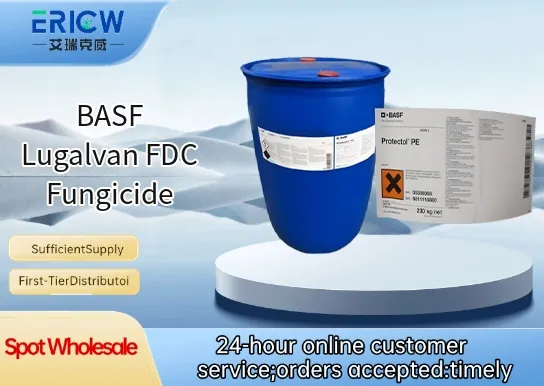
| Chemical Type | Multi-mode-of-action fungicide (containing fluopyram and trifloxystrobin) |
| Product Form | Flowable concentrate (SC) |
| Appearance | Brownish-black suspension, homogeneous upon shaking |
| Primary Applications | Foliar spray; seed treatment (in specific formulations) |
| Key Features | Preventive and curative activity; anti-resistance strategy via dual MOA |
| Benefits | Extended harvest intervals, improved yield quality, reduced reapplication frequency |
| Storage Conditions | Store in original container at 5–30 °C, away from direct sunlight and moisture |
| Shelf Life | 24 months from date of manufacture under recommended storage |
Q1: What is the primary mode of action of Lugalvan FDC Fungicide?
A: Lugalvan FDC Fungicide functions as a broad-spectrum contact fungicide, providing protective activity against a range of fungal pathogens commonly encountered in industrial water systems and polymer-based materials. Its efficacy relies on disruption of fungal cell membrane integrity and metabolic processes.
Q2: In which types of formulations is Lugalvan FDC typically incorporated?
A: Lugalvan FDC is widely used in water-based coatings, adhesives, sealants, construction mortars, and nonwoven textiles—particularly where long-term resistance to mold and mildew during storage or service life is required. It is compatible with many anionic and nonionic systems.
Q3: How should Lugalvan FDC be added to a formulation?
A: It is recommended to add Lugalvan FDC during the final stage of formulation, after pH adjustment and cooling, to preserve stability and activity. Pre-dilution in water or a compatible solvent may facilitate uniform dispersion, especially in viscous systems.
Q4: Is Lugalvan FDC suitable for use in applications requiring regulatory compliance for indirect food contact?
A: Lugalvan FDC is not intended for direct food contact applications. For indirect food contact scenarios, its suitability must be evaluated case-by-case based on applicable regional regulations, end-use conditions, and migration potential—consult BASF Technical Service for support on specific compliance pathways.
Q5: What are key handling and storage recommendations?
A: Store in original sealed containers at temperatures between 5 °C and 30 °C, protected from frost and prolonged exposure to UV light. Ensure adequate ventilation during handling, and refer to the Safety Data Sheet (SDS) for personal protective equipment and first-aid measures.
Contact With Us:
E-mail: wangxingqiang@ericwchem.com
Have a Questions? Call Us:
Add:
Building A1, Jiete Industrial Park, Huangpu District, Guangzhou City, Guangdong Province, China