English
 Español
 tiếng việt
 русский
Broad-spectrum fungicidal activity against key Ascomycete and Basidiomycete pathogens.
Systemic and protective action with translaminar mobility for extended residual control.
Low volatility and favorable environmental profile, supporting sustainable crop protection programs.
Compatible with major adjuvants and commonly used insecticides and fertilizers in tank mixes.
Stable under standard storage conditions (15–25°C), with shelf life exceeding 24 months in original sealed container.
Cereal crops including wheat, barley, and oats for control of Septoria tritici blotch and rusts.
Vineyards targeting downy mildew (Plasmopara viticola) and powdery mildew (Erysiphe necator).
Fruit orchards—especially apple and pear—for managing scab (Venturia inaequalis) and leaf spot diseases.
Leafy vegetables such as lettuce and spinach to suppress Botrytis cinerea and Alternaria spp.
| Chemical Type | Triazole-class systemic fungicide (active ingredient: prothioconazole) |
| Product Form | Flowable concentrate (FS) |
| Appearance | Off-white to light beige suspension |
| Active Ingredient Content | 750 g/L prothioconazole |
| Density (20°C) | Approx. 1.18 g/cm³ |
| pH Range (1% aqueous solution) | 6.0 – 7.5 |
| Solubility in Water | Low (3.2 mg/L at 20°C); formulated for stable aqueous dispersion |
| Primary Applications | Agricultural foliar fungicide for cereals, grapes, pome fruits, and leafy vegetables |
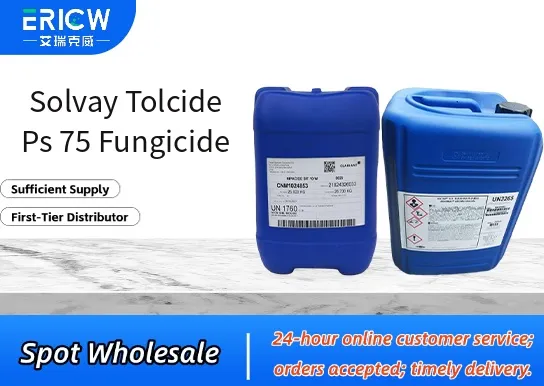
Q1: What is the primary mode of action of Solvay Tolcide Ps 75 Fungicide?
A: Solvay Tolcide Ps 75 functions as a broad-spectrum fungistatic agent, primarily inhibiting fungal growth through interference with essential metabolic pathways—particularly those involved in cell wall integrity and membrane function. Its active component exhibits strong efficacy against common spoilage fungi such as Aspergillus, Penicillium, and Cladosporium species.
Q2: In which types of industrial formulations is Solvay Tolcide Ps 75 typically incorporated?
A: It is widely used in water-based industrial coatings, adhesives, construction mortars, grouts, and non-food-contact polymer systems where long-term resistance to fungal colonization is required. It is not intended for use in food-contact or pharmaceutical applications without prior regulatory evaluation.
Q3: How should Solvay Tolcide Ps 75 be incorporated into a formulation?
A: The product is supplied as a stable aqueous dispersion and is generally added during the final stage of formulation—after pH adjustment and cooling—to preserve activity. It disperses readily in water-based systems and is compatible with most common surfactants and thickeners, though compatibility testing under actual process conditions is recommended.
Q4: Does Solvay Tolcide Ps 75 offer protection against bacterial growth as well?
A: While its primary design focus is antifungal performance, Solvay Tolcide Ps 75 may exhibit limited activity against certain Gram-positive bacteria under specific conditions. However, it is not classified or marketed as a broad-spectrum biocide for bacterial control, and dedicated bacteriostatic agents should be selected when robust antibacterial performance is required.
Q5: What storage conditions are recommended to maintain product stability?
A: Store in original sealed containers at temperatures between 5 °C and 30 °C, away from direct sunlight and freezing conditions. Prolonged exposure to temperatures above 40 °C or repeated freeze-thaw cycles may affect physical stability and performance consistency.
Contact With Us:
E-mail: wangxingqiang@ericwchem.com
Have a Questions? Call Us:
Add:
Building A1, Jiete Industrial Park, Huangpu District, Guangzhou City, Guangdong Province, China