English
 Español
 tiếng việt
 русский
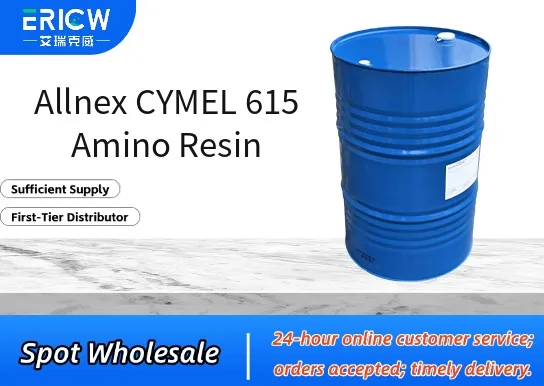
High reactivity with hydroxyl-functional resins, enabling efficient crosslinking at moderate cure temperatures.
Excellent compatibility with acrylic, polyester, and alkyd resin systems.
Low formaldehyde emission profile compared to conventional melamine-formaldehyde resins.
Good storage stability in solvent-based formulations when properly inhibited.
Delivers superior hardness, chemical resistance, and gloss retention in cured films.
Automotive OEM and refinish topcoats.
Industrial maintenance and appliance coatings.
Coil coating systems requiring rapid through-cure and excellent edge coverage.
Can and closure coatings for food and beverage packaging.
General-purpose baking enamels for metal substrates.
| Chemical Type | Melamine-formaldehyde crosslinker (partially methylated) |
| Product Form | Clear to pale yellow liquid |
| Appearance | Homogeneous, transparent liquid |
| Non-Volatile Content (wt%, ASTM D1817) | 70–74% |
| Viscosity (25°C, mPa·s, ASTM D1084) | 80–150 |
| Density (25°C, g/cm³, ASTM D1475) | 1.22–1.26 |
| pH (10% aqueous solution) | 7.5–9.0 |
| Solubility | Compatible with common organic solvents (e.g., xylene, butanol, PGDA) |
Q1: What is the primary function of CYMEL 615 in coating formulations?
A: CYMEL 615 functions as a highly reactive melamine-formaldehyde crosslinker, designed to enhance hardness, chemical resistance, and thermal stability in thermosetting coatings—particularly in high-gloss automotive and industrial finishes.
Q2: How does CYMEL 615 differ from other melamine resins in terms of curing behavior?
A: CYMEL 615 offers balanced reactivity—faster than fully alkylated melamines but with improved storage stability compared to partially methylated or butylated variants—enabling efficient cure at moderate baking temperatures (typically 140–160 °C) without excessive volatility or premature gelation.
Q3: Is CYMEL 615 compatible with hydroxyl-functional acrylics and polyesters?
A: Yes, CYMEL 615 is widely used with hydroxyl-terminated acrylic, polyester, and alkyd resins. Its methylol and methoxy groups readily undergo acid-catalyzed condensation with hydroxyl functionalities, forming durable three-dimensional networks under standard curing conditions.
Q4: What catalysts are commonly recommended for optimal performance with CYMEL 615?
A: Strong organic acids such as p-toluenesulfonic acid (p-TSA) or blocked acid catalysts are typically employed. Catalyst selection and dosage depend on the desired pot life, film formation requirements, and final cure schedule—generally ranging from 0.1% to 2% by weight relative to the total resin solids.
Q5: Does CYMEL 615 require special handling or storage precautions?
A: Yes—CYMEL 615 is moisture-sensitive and should be stored in tightly sealed containers under dry conditions. Prolonged exposure to humidity or elevated temperatures may lead to viscosity increase or premature condensation; it is recommended to use within 12 months of manufacture when stored properly.
Contact With Us:
E-mail: wangxingqiang@ericwchem.com
Have a Questions? Call Us:
Add:
Building A1, Jiete Industrial Park, Huangpu District, Guangzhou City, Guangdong Province, China