English
 Español
 tiếng việt
 русский
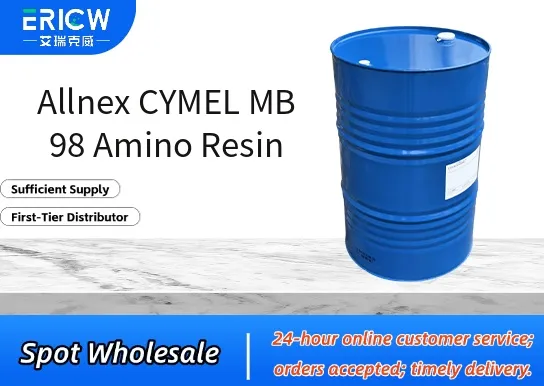
Highly reactive melamine-formaldehyde resin with excellent cure speed at low baking temperatures.
Outstanding compatibility with acrylic, polyester, and alkyd resins in solventborne coating systems.
Delivers superior hardness, chemical resistance, and gloss retention in thermoset coatings.
Low free formaldehyde content, supporting improved workplace safety and regulatory compliance.
Good storage stability in acidic catalyzed formulations when properly inhibited.
Automotive OEM and refinish topcoats requiring high durability and appearance.
Industrial maintenance coatings for metal substrates exposed to harsh environments.
Appliance coatings (e.g., refrigerators, washing machines) demanding scratch and stain resistance.
General-purpose coil coatings where rapid line speed and consistent film formation are critical.
| Chemical Type | Melamine-formaldehyde condensate |
| Product Form | Liquid |
| Appearance | Clear to pale yellow, homogeneous liquid |
| Non-Volatile Content (105 °C, 30 min) | 80.0 – 84.0 wt% |
| Viscosity (25 °C, Brookfield RV, spindle #3, 20 rpm) | 1,500 – 3,500 mPa·s |
| Acid Number (KOH, mg/g) | 2.0 – 5.0 |
| pH (10% aqueous solution) | 7.5 – 9.0 |
| Primary Applications | Thermosetting coatings for metal substrates |
Q1: What is the primary function of CYMEL MB 98 in coating formulations?
A: CYMEL MB 98 serves as a highly reactive melamine-formaldehyde crosslinker, enabling rapid cure at moderate temperatures and delivering excellent hardness, chemical resistance, and gloss retention in thermosetting coatings—particularly for metal decorating and coil coating applications.
Q2: Is CYMEL MB 98 compatible with hydroxyl-functional acrylic or polyester resins?
A: Yes, CYMEL MB 98 is specifically designed to efficiently crosslink with hydroxyl-terminated resins. It exhibits good compatibility and reactivity with standard hydroxyl-functional acrylics, polyesters, and alkyds used in industrial baking systems.
Q3: How does CYMEL MB 98 differ from conventional high-methylol melamine resins?
A: CYMEL MB 98 features a balanced methylolation level and optimized etherification, offering improved storage stability in solvent-based systems and reduced formaldehyde release during cure compared to traditional high-methylol types—while maintaining strong crosslinking efficiency and film integrity.
Q4: What are typical curing conditions when using CYMEL MB 98?
A: Effective cure is generally achieved at temperatures between 140 °C and 180 °C for 10–30 minutes, depending on substrate, film thickness, and formulation balance. Its reactivity profile supports both fast-line metal decorating and continuous coil coating processes.
Q5: Does CYMEL MB 98 require acid catalysis, and if so, what type is recommended?
A: While CYMEL MB 98 can react without catalyst under extended bake conditions, optimal performance typically benefits from mild acid catalysis—such as blocked p-toluenesulfonic acid (PTSA) or weak organic acids—to accelerate cure onset and improve through-cure without compromising pot life significantly.
Contact With Us:
E-mail: wangxingqiang@ericwchem.com
Have a Questions? Call Us:
Add:
Building A1, Jiete Industrial Park, Huangpu District, Guangzhou City, Guangdong Province, China