English
 Español
 tiếng việt
 русский
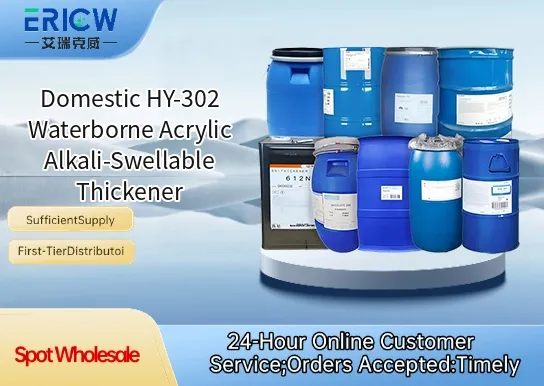
High-efficiency rheology control in low-to-medium pH systems after alkali activation.
Excellent compatibility with anionic surfactants and common waterborne acrylic, styrene-acrylic, and vinyl acetate copolymer emulsions.
Provides outstanding sag resistance and leveling balance in architectural and industrial coatings.
Low VOC contribution and APEO-free formulation compliant with modern environmental regulations.
Stable viscosity build-up with minimal batch-to-batch variation and good shear recovery performance.
Interior and exterior architectural wall paints.
Waterborne wood coatings for furniture and cabinetry.
Industrial maintenance coatings for metal substrates.
Water-based primers and undercoats.
Textile printing pastes requiring controlled flow behavior.
| Chemical Type | Acrylic-based alkali-swellable associative thickener (ASE) |
| Product Form | Aqueous dispersion |
| Appearance | Opaque white to off-white viscous liquid |
| pH (as supplied) | 2.5–4.0 |
| Solids Content | 28–32 wt% |
| Density (25°C) | 1.02–1.06 g/cm³ |
| Viscosity (Brookfield RVT, spindle #3, 20 rpm, 25°C) | 3,000–8,000 cP |
| Primary Applications | Rheology modifier for waterborne architectural and industrial coatings |
Q1: How does HY-302 differ from hydrophobically modified ethoxylated urethane (HEUR) thickeners?
A: HY-302 is an alkali-swellable acrylic polymer that thickens primarily through charge repulsion and chain expansion in neutralized alkaline conditions, delivering high low-shear viscosity and excellent water retention. Unlike HEUR thickeners—which rely on associative hydrophobic junctions—HY-302 offers stronger pseudoplasticity control and greater compatibility with ionic surfactants and high-electrolyte systems commonly found in architectural coatings and industrial waterborne formulations.
Q2: What pH range is required for optimal performance of HY-302?
A: HY-302 requires alkaline activation to fully swell and develop viscosity. It performs best when the formulation pH is adjusted to 8.0–9.5 using common neutralizing agents such as AMP-95, TEA, or sodium hydroxide. Below pH 7.5, viscosity development is significantly reduced; above pH 10.0, long-term stability may be compromised in some systems.
Q3: Can HY-302 be used in combination with other rheology modifiers?
A: Yes—HY-302 is frequently blended with cellulosic thickeners (e.g., HEC) or fumed silica to balance high-shear flow and sag resistance, or with HEUR thickeners to fine-tune mid-to-high shear response. Compatibility testing is recommended, particularly when combining with associative thickeners or high-ionic-strength additives, to avoid viscosity loss or instability.
Q4: Is HY-302 suitable for freeze-thaw stable formulations?
A: HY-302 itself exhibits good inherent freeze-thaw reversibility when properly neutralized and incorporated into well-designed waterborne systems. However, overall formulation freeze-thaw stability depends on the full ingredient set—including co-thickeners, surfactants, and co-solvents—so comprehensive testing per ASTM D2243 or equivalent is advised for critical applications.
Contact With Us:
E-mail: wangxingqiang@ericwchem.com
Have a Questions? Call Us:
Add:
Building A1, Jiete Industrial Park, Huangpu District, Guangzhou City, Guangdong Province, China