English
 Español
 tiếng việt
 русский
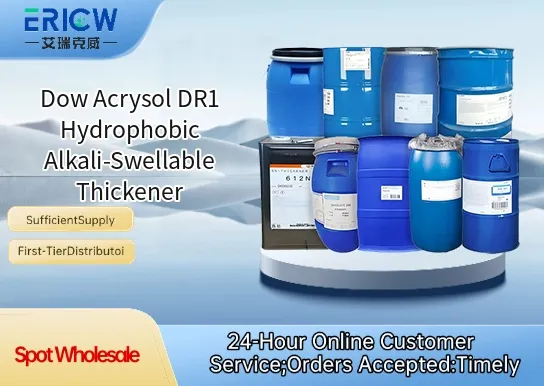
Delivers high-shear viscosity stability in waterborne coatings and inks.
Provides excellent sag resistance and leveling balance in architectural and industrial paints.
Offers robust rheology control under varying pH conditions (pH ≥ 8.5).
Enhances spatter resistance and brush/roller drag performance in latex-based formulations.
Compatible with common surfactants, co-thickeners, and biocides used in modern paint systems.
Interior and exterior architectural latex paints.
Textured coatings and elastomeric wall finishes.
Waterborne industrial maintenance coatings.
Low-VOC and zero-VOC decorative coatings.
Exterior wood stains and clear finishes.
| Chemical Type | Hydrophobically modified alkali-swellable emulsion (HASE) |
| Product Form | Aqueous dispersion |
| Appearance | Opaque white liquid |
| pH (as received) | 2.5–4.0 |
| Active Content (wt%) | 25–27% |
| Viscosity (Brookfield RVT, spindle #3, 20 rpm, 25°C) | 500–1,500 cP |
| Primary Applications | Rheology modifier for waterborne coatings |
| Key Features | Hydrophobic association, alkali-activated thickening, shear-thinning behavior |
Q1: How does DR1 differ from conventional alkali-swellable thickeners?
A: Unlike standard alkali-swellable thickeners, DR1 incorporates hydrophobic modifications that enhance associative thickening behavior—providing improved rheology control, better resistance to water dilution, and enhanced film formation in aqueous systems.
Q2: What types of formulations is DR1 typically used in?
A: DR1 is commonly employed in high-performance architectural coatings, industrial maintenance paints, and specialty decorative finishes where balanced viscosity development, sag resistance, and sprayability are required—especially in low-VOC and zero-VOC formulations.
Q3: How is DR1 activated and incorporated into a formulation?
A: DR1 is added as a pre-neutralized or post-neutralized dispersion, typically after the pigment grind phase. It requires alkaline conditions (pH ≥ 8.0) for full swelling and thickening performance; neutralization with common bases such as AMP-95™ or NaOH is recommended prior to addition.
Q4: Does DR1 offer compatibility with other rheology modifiers?
A: Yes, DR1 is generally compatible with cellulosic thickeners and certain associative nonionic thickeners, enabling hybrid rheology profiles. However, compatibility testing is advised when combining with highly hydrophobic or cationic additives due to potential interference with associative networks.
Q5: What is the typical dosage range for DR1 in finished formulations?
A: Dosage depends on formulation requirements and desired rheological profile, but DR1 is typically used at low concentrations—generally ranging from 0.1% to 2% by weight of the total formulation—to achieve effective viscosity build and stability.
Contact With Us:
E-mail: wangxingqiang@ericwchem.com
Have a Questions? Call Us:
Add:
Building A1, Jiete Industrial Park, Huangpu District, Guangzhou City, Guangdong Province, China