English
 Español
 tiếng việt
 русский
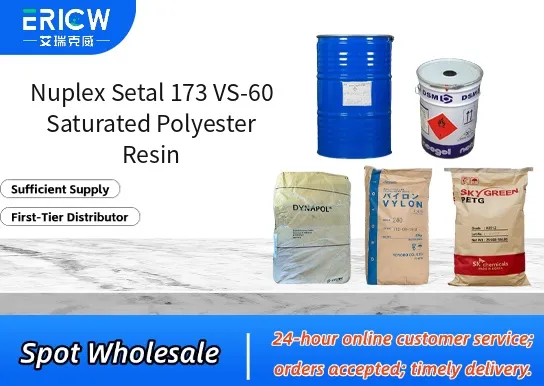
Low-viscosity liquid suitable for high-solids, low-VOC coating formulations.
Excellent compatibility with melamine formaldehyde crosslinkers and common solvents.
Provides outstanding hardness, gloss retention, and chemical resistance in cured films.
Designed for ambient or forced-dry curing systems with balanced reactivity and pot life.
Consistent batch-to-batch performance ensured through rigorous quality control and GMP-compliant manufacturing.
Automotive OEM and refinish topcoats requiring high durability and aesthetic performance.
Industrial maintenance coatings for metal substrates in architectural and agricultural equipment.
Powder coating base resins for hybrid (polyester-epoxy) and pure polyester systems.
General-purpose coil coating primers and topcoats for pre-painted steel and aluminum.
High-performance can and container coatings demanding excellent flexibility and corrosion resistance.
| Chemical Type | Saturated polyester resin |
| Product Form | Clear to pale yellow liquid |
| Appearance | Homogeneous, free from sediment or haze |
| Primary Applications | Thermosetting coatings (baked), powder coatings, coil coatings |
| Key Features | Low viscosity, high solids, melamine-reactive |
| Benefits | Reduced solvent demand, improved film formation, enhanced weathering resistance |
| Storage Conditions | Store in sealed containers at 15–25°C; protect from freezing and direct sunlight |
| Shelf Life | 12 months from date of manufacture under recommended storage conditions |
Q1: What is the primary application area for Setal 173 VS-60?
A: Setal 173 VS-60 is specifically designed for high-performance coil coating and can coatings, where excellent gloss retention, hardness development, and resistance to yellowing under UV exposure are required.
Q2: Is Setal 173 VS-60 compatible with melamine-formaldehyde crosslinkers?
A: Yes, it is formulated to react efficiently with standard alkylated melamine resins, enabling robust thermoset film formation with good cure response at typical industrial baking temperatures.
Q3: How does Setal 173 VS-60 differ from unsaturated polyester resins in terms of reactivity and handling?
A: As a saturated polyester, Setal 173 VS-60 contains no carbon–carbon double bonds and therefore does not undergo free-radical polymerization. It relies on condensation chemistry with amino crosslinkers, offering improved storage stability and reduced sensitivity to ambient inhibitors compared to unsaturated systems.
Q4: Can Setal 173 VS-60 be used in food-contact coatings?
A: While the resin itself is based on non-toxic monomers commonly accepted for indirect food contact applications, final regulatory compliance depends on the complete formulation, processing conditions, and intended use — users must conduct full regulatory assessment per target market requirements.
Contact With Us:
E-mail: wangxingqiang@ericwchem.com
Have a Questions? Call Us:
Add:
Building A1, Jiete Industrial Park, Huangpu District, Guangzhou City, Guangdong Province, China