English
 Español
 tiếng việt
 русский
Excellent melt processability for high-speed extrusion and injection molding
Outstanding low-temperature flexibility and impact resistance
Superior compatibility with polypropylene (PP) and polyethylene (PE) matrices
High elasticity and recovery performance after deformation
Good clarity and gloss in thin-gauge applications
Automotive interior trim components (e.g., instrument panels, door armrests)
Polypropylene modification for impact-modified PP compounds
Flexible packaging films requiring toughness and seal integrity
Soft-touch overmolding for consumer electronics and appliances
Medical tubing and non-PVC flexible devices
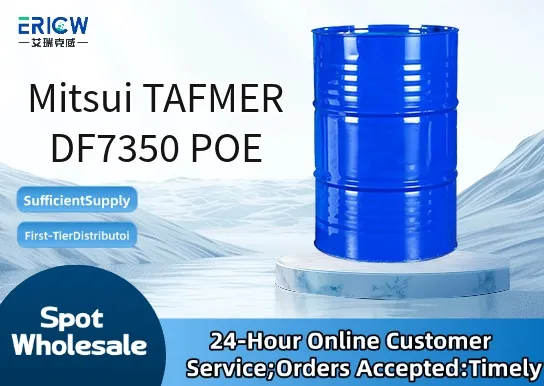
| Chemical Type | Ethylene-octene copolymer (Polyolefin Elastomer, POE) |
| Product Form | Pellets |
| Appearance | Off-white to light yellow cylindrical pellets |
| Primary Applications | PP/PE modification, soft-touch overmolding, flexible packaging |
| Key Features | Low hardness, high elasticity, excellent flow |
| Benefits | Enhanced impact strength, improved processability, reduced energy consumption |
| Density (g/cm³) | 0.870–0.875 |
| Melt Flow Rate (190°C/2.16 kg, g/10 min) | 25–35 |
Q1: What is the primary functional role of TAFMER DF7350 in polymer blends?
A: TAFMER DF7350 is a polyolefin elastomer (POE) designed primarily as a toughening agent and impact modifier—especially for polypropylene (PP) and polyethylene (PE) systems—enhancing low-temperature ductility, melt elasticity, and phase adhesion without significantly compromising stiffness or processability.
Q2: Is TAFMER DF7350 suitable for use in food-contact applications?
A: TAFMER DF7350 is manufactured to meet stringent purity requirements for indirect food-contact applications where permitted by regional regulatory frameworks. Its suitability depends on final formulation, processing conditions, and end-use compliance verification—not on the base resin alone.
Q3: How does DF7350 compare to conventional EPDM or EPR impact modifiers in PP compounds?
A: Unlike traditional EPDM or EPR modifiers, DF7350 offers superior compatibility with polyolefins due to its ethylene–octene copolymer structure, resulting in finer dispersion, improved interfacial adhesion, and more consistent mechanical balance—particularly in thin-wall or high-flow injection molding applications.
Q4: What are typical processing recommendations for TAFMER DF7350?
A: DF7350 processes readily on standard polyolefin equipment—including extruders and injection molding machines—with melt temperatures generally ranging from 180 °C to 230 °C. It exhibits good thermal stability under typical residence times and requires no special drying prior to processing.
Contact With Us:
E-mail: wangxingqiang@ericwchem.com
Have a Questions? Call Us:
Add:
Building A1, Jiete Industrial Park, Huangpu District, Guangzhou City, Guangdong Province, China