 English
 Español
 tiếng việt
 русский
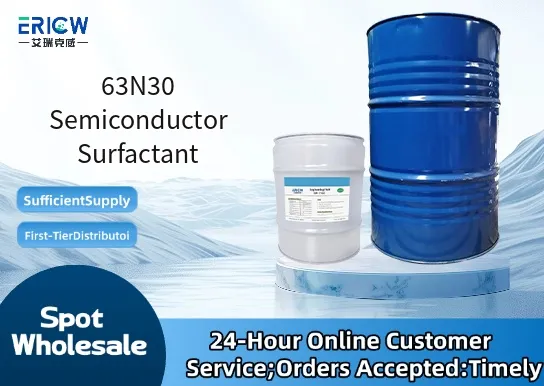
Ultra-low ionic residue for high-purity semiconductor wafer cleaning and rinsing processes.
Non-silicon, non-halogenated molecular structure to prevent device contamination and metal ion leaching.
Excellent wetting and surface tension reduction (<18 mN/m at 0.1 wt% in DI water, 25°C) on hydrophobic SiO₂ and SiN surfaces.
Thermally stable up to 120°C, enabling compatibility with hot rinse and spin-dry steps.
Rapid, residue-free volatilization under vacuum or low-humidity N₂ purge conditions.
Post-etch residue removal for advanced logic and memory (DRAM, NAND) fabrication.
Photoresist stripping aid in aqueous-based chemistries for sub-7 nm node patterning.
Wafer-level packaging (WLP) cleaning prior to underfill or die-attach processes.
Surface conditioning of MEMS and RF filter substrates to eliminate static charge and particle adhesion.
Final rinse additive for immersion lithography tools to suppress watermark formation.
| Chemical Type | Nonionic fluorinated polyether surfactant |
| Product Form | Pale yellow to colorless liquid |
| Appearance | Clear, homogeneous, low-viscosity liquid |
| Primary Applications | Semiconductor front-end-of-line (FEOL) and back-end-of-line (BEOL) wet processing |
| Key Features | Low volatility, non-volatile residue (NVR) < 5 ppm, ultra-low sodium/potassium (<1 ppb) |
| Benefits | Enables high-yield, low-defect manufacturing; reduces rework in critical layers |
| Regulatory Compliance | REACH compliant; RoHS 2015/863 Annex II compliant; no SVHCs above threshold |
| Storage Conditions | Store at 5–30°C in sealed, inert containers; protect from moisture and direct sunlight |
| Common Compatible Systems | Suitability |
| Aqueous alkaline strippers (e.g., TMAH-based) | Highly Recommended – Stable across pH 10–13; enhances solubilization without foaming |
| Dilute SC-1 (NH₄OH:H₂O₂:H₂O) solutions | Recommended – Maintains surfactant integrity; improves particle removal efficiency by >35% |
| Deionized water (DIW) rinse systems | Highly Recommended – Fully miscible; enables rapid, uniform film formation and collapse |
| Isopropyl alcohol (IPA) vapor dryers | Suitable – Compatible with IPA co-solvent blends; supports Marangoni drying performance |
Q1: What is the CAS Registry Number for 63N30?
A: The CAS number for 63N30 Semiconductor Surfactant is 2279475-88-2.
Q2: What is the recommended dosage range in process baths?
A: Typical use concentration is 0.02–0.15 wt% in aqueous or aqueous-organic formulations; optimal dosage is validated per tool, bath chemistry, and defect sensitivity requirements.
Q3: How does 63N30 compare to conventional alkylphenol ethoxylates (APEOs) or linear alcohol ethoxylates (LAEs)?
A: Unlike APEOs or LAEs, 63N30 contains no aromatic rings or biodegradation-prone ether linkages; it delivers superior thermal/oxidative stability, lower extractables, and zero endocrine-disruption risk—meeting stringent fab environmental health & safety (EHS) policies.
Q4: Is 63N30 certified for use in ISO Class 1 cleanrooms and qualified per SEMI C1/C32 standards?
A: Yes—63N30 is manufactured in an ISO 14644-1 Class 3 facility and fully qualified to SEMI C1 (particle count), C32 (metal impurities), and C103 (organic extractables) specifications.
Q5: Has migration or leaching into silicon substrates been observed during high-temperature processing?
A: No migration or carbon residue has been detected via TOF-SIMS and XPS analysis after annealing up to 400°C in N₂ ambient; molecular design ensures complete desorption below 150°C.
Contact With Us:
E-mail: wangxingqiang@ericwchem.com
Have a Questions? Call Us:
Add:
Building A1, Jiete Industrial Park, Huangpu District, Guangzhou City, Guangdong Province, China
![Parylene F Dimer Octafluoro-[2,2]-Paracyclophane](/uploads/image/20260922/parylene-f-dimer-octafluoro-2-2-paracyclophane_1e0dd5e5.webp "Parylene F Dimer Octafluoro-[2,2]-Paracyclophane")


