English
 Español
 tiếng việt
 русский
High thermal stability with decomposition onset above 400 °C, enabling robust high-temperature vapor deposition processes.
Exceptional chemical resistance to strong acids, bases, solvents, and oxidizing agents due to fully fluorinated aromatic backbone.
Low dielectric constant (~2.35 at 1 MHz) and ultra-low dissipation factor, ideal for high-frequency electronic insulation.
Superior UV stability and weather resistance compared to non-fluorinated parylenes (e.g., Parylene N or C).
Provides pinhole-free, conformal, and stress-free polymeric coatings after pyrolytic dimer-to-monomer conversion and polymerization.
Protective coating for aerospace sensors and avionics exposed to extreme temperature cycling and aggressive chemical environments.
Dielectric encapsulation of implantable medical devices requiring long-term biostability and fluoropolymer inertness.
Moisture and corrosion barrier for high-reliability MEMS, RF filters, and millimeter-wave components.
Surface passivation layer for semiconductor test probes and precision microelectrodes in harsh analytical environments.
Functional coating for lithium-ion battery current collectors to suppress electrolyte side reactions and transition metal dissolution.
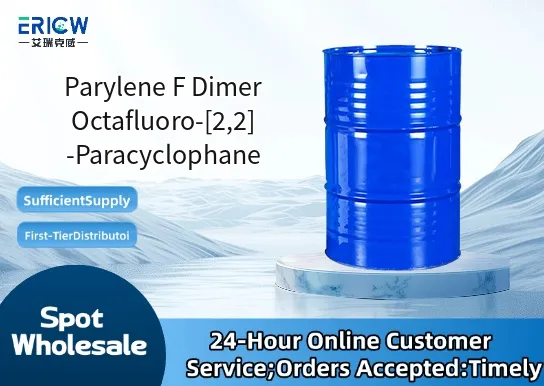
| Chemical Type | Fluorinated [2.2]paracyclophane dimer (C₁₆F₈H₈) |
| Product Form | Crystalline solid powder |
| Appearance | White to off-white free-flowing crystalline powder |
| Melting Point | 298–302 °C (determined by DSC, onset) |
| Primary Applications | Precursor for Parylene AF-4 polymer via vacuum pyrolysis and CVD |
| Key Features | Thermally stable dimer; high monomer yield (>95%) under standard pyrolysis conditions (680–700 °C) |
| Benefits | Enables formation of highly fluorinated, amorphous, non-crystalline poly(p-xylylene) with superior oxidation resistance |
| Regulatory Compliance | REACH registered; RoHS compliant; no SVHCs listed per current ECHA Candidate List |
| Common Compatible Systems | Suitability |
| SCS PDS 2010 / 2020 Series Coaters | Highly Recommended – Optimized for controlled dimer sublimation and monomer generation |
| Specialty Coating Systems (SCS) LabCoater® LC-1000 | Highly Recommended – Precise temperature ramp profiles ensure minimal charring |
| Gasclean™ Parylene Deposition Systems | Recommended – Requires minor calibration for optimal vapor pressure control |
| Custom-built CVD reactors with quartz-lined hot zones | Suitable – Must maintain ≥650 °C pyrolysis zone and ≤25 °C cold trap |
Q1: What is the CAS Registry Number for Parylene F Dimer Octafluoro-[2,2]-Paracyclophane?
A: The CAS Number is 35142-79-9.
Q2: How does recommended usage amount compare to Parylene C dimer in standard coating processes?
A: Due to higher molecular weight and lower vapor pressure, typical mass loading is ~10–15% greater than Parylene C dimer for equivalent coating thickness; deposition rate is ~20–25% slower under identical reactor settings.
Q3: Is Parylene F Dimer compliant with ISO 10993 and USP Class VI for biomedical use?
A: The *polymer* (Parylene AF-4) derived from this dimer meets ISO 10993-5/-10 biocompatibility requirements and USP <788> extractables limits when processed under validated GMP conditions; however, the dimer itself is not tested or certified — only the final cured coating is evaluated.
Q4: Are there known migration or leachable concerns during sterilization (e.g., EtO, gamma)?
A: No significant monomer or oligomer migration occurs post-polymerization; Parylene AF-4 exhibits negligible extractables (<0.1 μg/cm²) under ISO 10993-12 extraction protocols, even after gamma irradiation up to 50 kGy.
Contact With Us:
E-mail: wangxingqiang@ericwchem.com
Have a Questions? Call Us:
Add:
Building A1, Jiete Industrial Park, Huangpu District, Guangzhou City, Guangdong Province, China