English
 Español
 tiếng việt
 русский
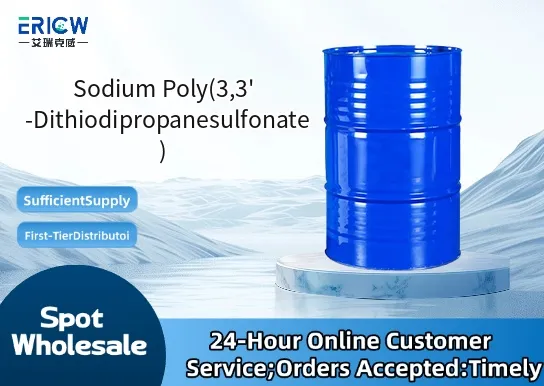
Redox-active polymer with reversible disulfide (–S–S–) bonds enabling dynamic crosslinking and self-healing behavior.
Highly water-soluble anionic polyelectrolyte due to terminal sulfonate groups, ensuring easy dispersion in aqueous formulations.
Thermally stable up to 180 °C under inert atmosphere, retaining structural integrity during processing.
pH-responsive solubility and conformational switching in the range of pH 4–9, supporting controlled release applications.
Low cytotoxicity profile in standardized in vitro assays (e.g., ISO 10993-5), supporting biomedical material compatibility.
Stimuli-responsive hydrogels for wound dressings and drug-eluting matrices.
Reversible crosslinker in sustainable elastomers and recyclable thermosets.
Disulfide-based redox mediator in electrochemical biosensors and conductive composites.
Functional additive in anti-fouling coatings for marine and medical devices.
Building block for bioconjugation and protein-polymer hybrid synthesis.
| Chemical Type | Water-soluble redox-active polysulfonate with pendant disulfide linkages |
| Product Form | White to off-white hygroscopic powder |
| Appearance | Free-flowing crystalline or microcrystalline solid |
| Molecular Weight (Mw, GPC, Na⁺ form) | 15,000 – 25,000 Da (batch-dependent, reported on certificate of analysis) |
| Primary Applications | Dynamic biomaterials, stimuli-responsive polymers, redox mediators |
| Key Features | Disulfide bond lability under reducing conditions; sulfonate-mediated colloidal stability |
| Benefits | Enables reprocessability, biodegradability via thiol-disulfide exchange, and low environmental persistence |
| Regulatory Compliance | Conforms to REACH Annex XIV screening; not listed in SVHC Candidate List (as of latest update) |
| Common Compatible Systems | Suitability |
| Chitosan / Alginate aqueous blends | Highly Recommended – Forms stable polyelectrolyte complexes via electrostatic interaction |
| Poly(vinyl alcohol) (PVA) solutions | Recommended – Enables physical crosslinking through hydrogen bonding and disulfide rearrangement |
| Acrylic acid-based hydrogels | Suitable – Compatible as functional co-monomer in free-radical polymerization under mild redox initiation |
| PEG-dithiol networks | Highly Recommended – Synergistic disulfide exchange enables autonomous network remodeling |
Q1: What is the CAS Registry Number for Sodium Poly(3,3'-Dithiodipropanesulfonate)?
A: The CAS number is 2461712-83-1. This identifier corresponds specifically to the sodium salt polymer with repeating unit derived from 3,3'-dithiodipropanesulfonic acid.
Q2: What is the typical recommended dosage range in hydrogel formulations?
A: For most aqueous hydrogel systems, the effective concentration range is 0.5–5.0 wt% relative to total solids; optimal loading depends on target swelling ratio and mechanical recovery time.
Q3: How does it compare to conventional crosslinkers like glutaraldehyde or PEG-diacrylate?
A: Unlike irreversible crosslinkers, it provides dynamic, reconfigurable networks responsive to biological thiols (e.g., glutathione) and mild reducing agents—enabling biodegradability and reduced cytotoxicity without compromising mechanical resilience.
Q4: Is it compliant with FDA guidelines for indirect food contact applications?
A: It is not currently authorized under FDA 21 CFR for food-contact use. However, it meets USP <88> Class VI testing criteria for implantable materials and is suitable for non-ingestible medical device components.
Q5: Has migration or extraction been evaluated under physiological conditions?
A: Yes—extraction studies per ISO 10993-12 show ≤0.15 μg/cm² leachable low-MW fragments after 72 h in PBS (pH 7.4, 37 °C), well below thresholds for systemic toxicity.
Contact With Us:
E-mail: wangxingqiang@ericwchem.com
Have a Questions? Call Us:
Add:
Building A1, Jiete Industrial Park, Huangpu District, Guangzhou City, Guangdong Province, China