English
 Español
 tiếng việt
 русский
High-performance, two-part addition-cure liquid silicone rubber (LSR) with excellent flowability and low viscosity for precision molding.
Offers outstanding thermal stability and long-term reliability across a wide service temperature range (–60 °C to 200 °C).
Meets UL 94 V-0 flammability rating for enhanced safety in demanding electronic and automotive applications.
Low compression set and superior mechanical resilience ensure consistent sealing and gasketing performance over time.
Biocompatibility tested per ISO 10993–5 and USP Class VI, supporting medical device manufacturing requirements.
Medical device components including seals, gaskets, and wearable sensor housings.
Automotive under-hood sensors, ignition system parts, and EV battery module encapsulation.
Consumer electronics: waterproof seals for smartwatches, hearing aids, and portable diagnostic equipment.
Industrial connectors and high-reliability electrical insulators requiring long-term environmental resistance.
LED lighting encapsulants and optical lenses where clarity, UV stability, and thermal management are critical.
| Chemical Type | Platinum-catalyzed addition-cure liquid silicone rubber (LSR) |
| Product Form | Two-component (Part A + Part B), supplied separately |
| Appearance | Translucent, low-viscosity liquid (Part A); translucent liquid catalyst (Part B) |
| Mix Ratio (by weight) | 10:1 (A:B) |
| Cure Temperature Range | 100 °C to 180 °C (fast cure); room-temperature post-cure optional |
| Hardness (Shore A) | 50 ± 3 |
| Tensile Strength | 7.0 MPa (typical, ASTM D412) |
| Elongation at Break | 220% (typical, ASTM D412) |
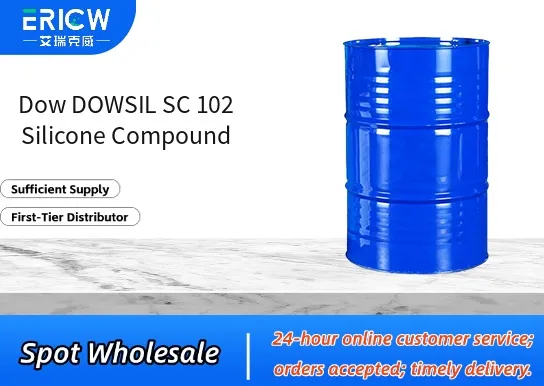
Q1: What is the primary function of DOWSIL SC 102 in polymer systems?
A: DOWSIL SC 102 is a silicone-based processing aid designed to improve melt flow, reduce extrusion pressure, and enhance surface finish in thermoplastic and thermoset compounds—particularly in engineering resins such as polyamide, polyester, and polyolefins.
Q2: Is DOWSIL SC 102 compatible with filled or reinforced polymer formulations?
A: Yes, it demonstrates good compatibility with common fillers (e.g., glass fiber, talc, calcium carbonate) and reinforcements. It helps mitigate filler-induced melt viscosity increases and supports uniform dispersion without compromising mechanical performance.
Q3: How is DOWSIL SC 102 typically incorporated into production processes?
A: It is commonly added during compounding—either directly into the extruder feed throat or pre-blended with base resin—using standard high-shear equipment. Its liquid consistency allows for straightforward metering and homogeneous distribution at low addition levels.
Q4: Does DOWSIL SC 102 affect the thermal stability or long-term aging behavior of finished parts?
A: When used within recommended dosage ranges, it does not significantly impair thermal stability or accelerate oxidative degradation. Its inert silicone backbone contributes to consistent performance under typical processing and end-use temperature conditions.
Contact With Us:
E-mail: wangxingqiang@ericwchem.com
Have a Questions? Call Us:
Add:
Building A1, Jiete Industrial Park, Huangpu District, Guangzhou City, Guangdong Province, China