English
 Español
 tiếng việt
 русский
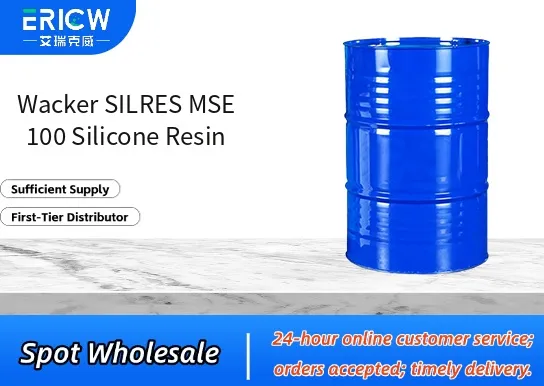
High thermal stability up to 250 °C for extended service life in demanding environments.
Excellent weather resistance and UV stability, maintaining performance under prolonged outdoor exposure.
Good compatibility with organic resins and pigments, enabling formulation flexibility in hybrid systems.
Low surface energy providing inherent water repellency and anti-soiling properties.
Solvent-based liquid format ensures easy handling and straightforward integration into existing coating processes.
High-performance architectural coatings for façades and concrete protection.
Heat-resistant coatings for industrial equipment and exhaust components.
Water-repellent impregnations for natural stone, masonry, and precast concrete.
Hybrid silicone-acrylic topcoats requiring enhanced durability and gloss retention.
Functional additives in fire-retardant and intumescent coating systems.
| Chemical Type | Methyl/phenyl silicone resin |
| Product Form | Liquid, solvent-based solution |
| Appearance | Clear, pale yellow liquid |
| Solvent | Xylene and aromatic hydrocarbon mixture |
| Non-Volatile Content | Approx. 50 wt.% |
| Viscosity (25 °C) | Approx. 15–25 mPa·s |
| Density (20 °C) | Approx. 0.92–0.94 g/cm³ |
| Flash Point (PMCC) | Approx. 35 °C |
Q1: What is the primary function of SILRES MSE 100 in coating and paint formulations?
A: SILRES MSE 100 is a methyl silicone resin designed to enhance weather resistance, water repellency, and substrate adhesion—particularly on mineral surfaces such as concrete, plaster, and masonry. It functions as a reactive binder or performance modifier that improves durability without compromising breathability.
Q2: Is SILRES MSE 100 compatible with organic polymer dispersions like acrylics or styrene-acrylics?
A: Yes, SILRES MSE 100 is formulated for compatibility with common aqueous polymer dispersions. It can be incorporated directly into water-based systems via high-shear mixing and typically remains stable in pH ranges between 7 and 10, though compatibility should be verified under actual formulation conditions.
Q3: How does SILRES MSE 100 contribute to hydrophobization of building materials?
A: Upon curing, SILRES MSE 100 forms a hydrophobic, siloxane-rich network within the pore structure of mineral substrates. This reduces capillary water absorption while maintaining vapor permeability—supporting long-term protection against moisture-related degradation without trapping internal moisture.
Q4: What is the recommended method for incorporating SILRES MSE 100 into aqueous systems?
A: SILRES MSE 100 is supplied as an aqueous dispersion and is generally added during the let-down stage under moderate agitation. It is typically used at low concentrations—generally ranging from 0.1% to 2% by weight relative to total formulation—and dosage depends on the desired performance level and substrate requirements.
Contact With Us:
E-mail: wangxingqiang@ericwchem.com
Have a Questions? Call Us:
Add:
Building A1, Jiete Industrial Park, Huangpu District, Guangzhou City, Guangdong Province, China