English
 Español
 tiếng việt
 русский
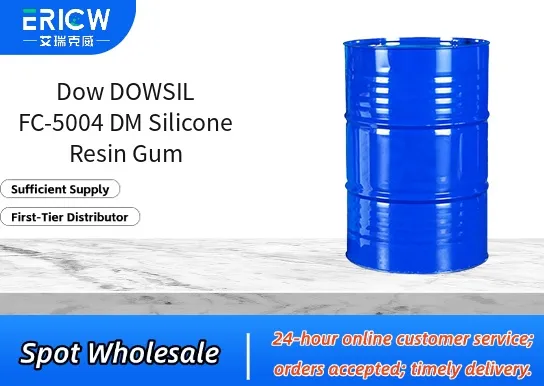
High-molecular-weight methyl-phenyl silicone resin gum offering exceptional thermal stability and oxidative resistance.
Self-adhesive and tacky at room temperature, enabling direct incorporation into silicone elastomer and coating formulations without additional tackifiers.
Excellent compatibility with polydimethylsiloxane (PDMS) polymers and silicone fluids, facilitating homogeneous blending in high-viscosity systems.
Provides enhanced mechanical reinforcement and improved tear strength when compounded into high-performance silicone rubbers.
Solvent-free, 100% reactive silicone resin gum — supports low-VOC and environmentally compliant formulation strategies.
High-temperature resistant silicone elastomers for automotive gaskets and under-hood sealing components.
Thermal management materials including thermally conductive gap fillers and potting compounds.
Release coatings for high-release-demand applications such as specialty paper and composite mold liners.
Reinforcing additive in liquid silicone rubber (LSR) formulations for medical-grade and food-contact parts.
Base resin for heat-curable silicone coatings used in industrial protective and electrical insulation applications.
| Chemical Type | Methyl-phenyl silicone resin gum |
| Product Form | Viscous, semi-solid gum |
| Appearance | Translucent to light amber, non-crystalline mass |
| Primary Applications | Reinforcement, adhesion promotion, thermal stabilization in silicone elastomers and coatings |
| Key Features | Self-tacky, solvent-free, high thermal stability, PDMS-compatible |
| Benefits | Improved tear strength, simplified compounding, reduced VOC, extended service life at elevated temperatures |
| Storage Conditions | Store in original sealed container at 15–25°C; protect from moisture and contamination |
| Shelf Life | 24 months from date of manufacture when stored properly |
Q1: What is the primary function of DOWSIL FC-5004 DM in coating and ink formulations?
A: DOWSIL FC-5004 DM functions as a silicone resin gum that imparts surface modification properties—enhancing slip, mar resistance, and substrate wetting—without significantly compromising film integrity or intercoat adhesion in solvent-based and high-solids systems.
Q2: Is DOWSIL FC-5004 DM compatible with common organic resins and crosslinkers?
A: Yes, it demonstrates good compatibility with acrylics, polyesters, alkyds, and melamine formaldehyde crosslinkers in typical industrial coating formulations. Compatibility should be verified empirically in each specific system due to variations in polarity, molecular weight, and solvent composition.
Q3: How is DOWSIL FC-5004 DM typically incorporated into a formulation?
A: It is generally added during the let-down stage under moderate agitation. Pre-dilution in a compatible solvent (e.g., xylene, butyl acetate, or glycol ether) is recommended to ensure uniform dispersion and avoid localized gelation or viscosity spikes.
Q4: Does DOWSIL FC-5004 DM affect cure kinetics or final film hardness?
A: It does not act as a catalyst or reactive component, so it typically has minimal impact on thermal or ambient cure profiles. However, at higher loadings, it may slightly reduce pencil hardness or crosslink density—formulators are advised to optimize dosage based on performance priorities.
Q5: Can DOWSIL FC-5004 DM be used in food-contact coatings?
A: While it is designed for industrial and protective coating applications, suitability for food-contact use depends on full regulatory assessment of the final cured film—including extraction behavior, migration potential, and compliance with applicable regional requirements. Dow does not pre-certify this grade for direct food contact without full formulation-level evaluation.
Contact With Us:
E-mail: wangxingqiang@ericwchem.com
Have a Questions? Call Us:
Add:
Building A1, Jiete Industrial Park, Huangpu District, Guangzhou City, Guangdong Province, China