English
 Español
 tiếng việt
 русский
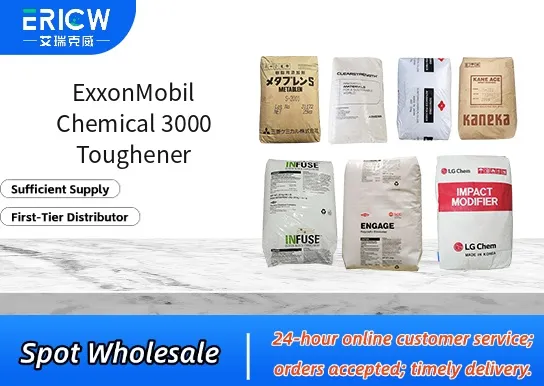
Enhances impact resistance and ductility in rigid thermoplastic formulations without compromising stiffness.
Offers excellent compatibility with polypropylene (PP) and polyethylene (PE) matrices for uniform dispersion.
Enables low-temperature toughness retention down to –20 °C in automotive and industrial components.
Supports high-speed processing via injection molding and extrusion with minimal viscosity penalty.
Provides consistent performance across batch variations due to tightly controlled molecular weight distribution.
Automotive interior trim, including dashboards, door panels, and pillar covers.
Industrial containers and reusable shipping totes requiring drop-impact durability.
Power tool housings and appliance components subjected to mechanical stress.
Medical device trays and packaging where sterilization stability and toughness are critical.
| Chemical Type | Ethylene–propylene rubber (EPR) based thermoplastic elastomer |
| Product Form | Pellets (free-flowing, cylindrical) |
| Appearance | Off-white to light tan, semi-crystalline granules |
| Primary Applications | Polypropylene and polyethylene impact modification |
| Key Features | Low-density, high-elongation, shear-stable morphology |
| Benefits | Improved crack propagation resistance, reduced part warpage, recyclability in PP/PE streams |
| Processing Temperature Range | 180–240 °C (recommended) |
| Storage Conditions | Keep dry at ambient temperature; avoid prolonged exposure to UV or humidity |
Contact With Us:
E-mail: wangxingqiang@ericwchem.com
Have a Questions? Call Us:
Add:
Building A1, Jiete Industrial Park, Huangpu District, Guangzhou City, Guangdong Province, China