English
 Español
 tiếng việt
 русский
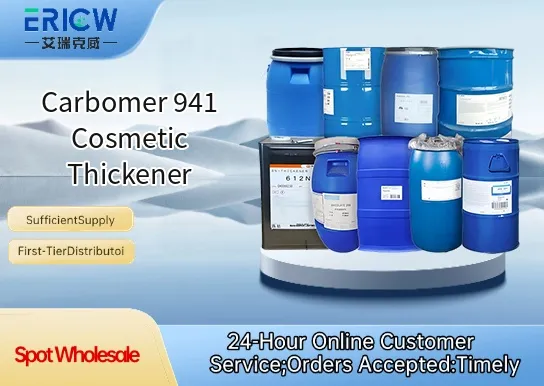
High-efficiency rheology modifier delivering exceptional viscosity build-up at low use levels (0.1–0.5% w/w).
Excellent clarity and transparency in aqueous systems, ideal for premium clear gels and serums.
pH-responsive thickening with optimal performance in the pH range of 5.5–7.0 after neutralization.
Superior suspension capability for insoluble actives, pigments, and exfoliants without syneresis.
Compatible with a broad spectrum of cosmetic ingredients including surfactants, emollients, and preservatives.
Clear facial gels and soothing post-procedure cooling gels.
Water-based serums and vitamin C or hyaluronic acid formulations.
Shower gels and liquid soaps requiring mild, non-irritating viscosity control.
Makeup removers and micellar water systems.
Anti-acne gels and topical treatment bases with suspended active agents.
| Chemical Type | Crosslinked polyacrylic acid (carbomer) |
| Product Form | Free-flowing white to off-white powder |
| Appearance | White, fluffy, odorless powder |
| Primary Applications | Viscosity control and stabilization in aqueous cosmetic gels and liquids |
| Key Features | High clarity, excellent suspension, low usage level, easy neutralization |
| Neutralization Agent | Triethanolamine (TEA), sodium hydroxide (NaOH), or sodium bicarbonate |
| Recommended Storage | Sealed container, dry conditions, 15–30°C |
| Compliance | USP/NF, Ph. Eur., JP, ISO 22716-compliant manufacturing |
Q1: What is the primary functional role of Carbomer 941 in cosmetic formulations?
A: Carbomer 941 is a high-molecular-weight polyacrylic acid polymer primarily used as a rheology modifier—providing viscosity enhancement, gel structure formation, and suspension stabilization in aqueous-based cosmetic systems such as gels, lotions, and serums.
Q2: How does Carbomer 941 differ from other Carbomer grades like 980 or 934?
A: Carbomer 941 offers a finer particle size and higher solution clarity compared to many standard grades, making it especially suitable for transparent gels and high-shear applications. Its viscosity profile and neutralization response are optimized for rapid dispersion and smooth, non-stringy gel formation.
Q3: What neutralizing agents are compatible with Carbomer 941?
A: Common neutralizing agents include triethanolamine (TEA), sodium hydroxide (NaOH), and sodium hydroxide solutions. The choice depends on desired pH stability, sensory profile, and compatibility with other formulation ingredients—neutralization typically occurs within the pH range of 5.5–7.0 for optimal thickening performance.
Q4: Is Carbomer 941 suitable for use in leave-on versus rinse-off products?
A: Yes—Carbomer 941 is widely used in both leave-on (e.g., facial gels, moisturizers) and rinse-off (e.g., shampoos, body washes) applications. Its film-forming properties and compatibility with surfactants make it versatile across product categories, though final suitability should be confirmed through stability and sensory testing.
Contact With Us:
E-mail: wangxingqiang@ericwchem.com
Have a Questions? Call Us:
Add:
Building A1, Jiete Industrial Park, Huangpu District, Guangzhou City, Guangdong Province, China