English
 Español
 tiếng việt
 русский
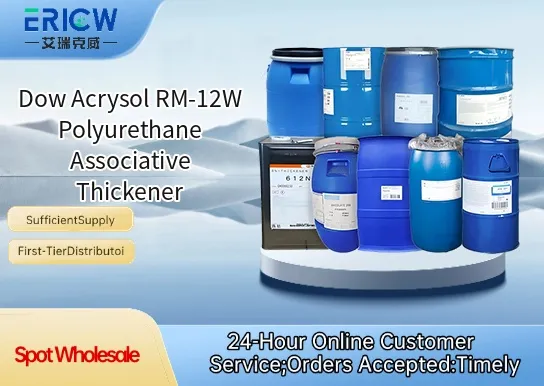
Provides excellent mid-shear viscosity build and outstanding flow/leveling balance in waterborne coatings.
Delivers robust rheology control with high resistance to microbial degradation and low sensitivity to electrolytes.
Offers superior compatibility with a broad range of latex polymers, pigments, and common formulation additives.
Enables low foaming performance and easy incorporation without high-shear mixing or pre-dilution.
Supports VOC-compliant formulations with zero APEO and no added formaldehyde.
Architectural interior and exterior flat and low-sheen paints.
Industrial maintenance coatings for metal and concrete substrates.
Wood coatings including stains, sealers, and clear finishes.
Waterborne primers and undercoats requiring sag resistance and brush/roller performance.
Decorative wall coatings and textured finishes.
| Chemical Type | Polyurethane associative thickener (non-ionic) |
| Product Form | Aqueous dispersion |
| Appearance | Opaque white to off-white liquid |
| pH (1% aqueous solution) | 6.5 – 8.5 |
| Non-Volatile Content (wt%) | 29.0 – 31.0 |
| Viscosity (Brookfield RVT, Spindle #3, 20 rpm, 25°C) | 500 – 2,500 cP |
| Freeze-Thaw Stability | Pass (3 cycles at –15°C / 24 h, then 25°C / 24 h) |
| Primary Applications | Waterborne architectural and industrial coatings |
Q1: What is the primary function of Acrysol RM-12W in waterborne coatings and inks?
A: Acrysol RM-12W is a hydrophobically modified polyurethane (HEUR) associative thickener designed to provide efficient rheology control—particularly high-shear viscosity and flow/leveling balance—in low-VOC, waterborne architectural paints, industrial coatings, and pigment dispersions.
Q2: How does RM-12W differ from cellulosic or acrylic thickeners?
A: Unlike non-associative thickeners, RM-12W functions through reversible hydrophobic associations in aqueous systems, delivering superior sag resistance, spatter resistance, and brush/roller feel—without the high low-shear viscosity or poor compatibility often seen with cellulose ethers or associative acrylics.
Q3: Is RM-12W compatible with common co-thickeners and surfactants used in architectural paints?
A: Yes—RM-12W is generally compatible with nonionic surfactants and can be effectively combined with other associative thickeners (e.g., HEUR or HASE types) for synergistic rheology tuning. However, compatibility should be verified experimentally when used with high levels of anionic surfactants or certain biocides.
Q4: What is the recommended addition method for optimal performance?
A: RM-12W is typically added during the let-down stage, either neat or pre-diluted with water or a water-miscible solvent. To ensure uniform dispersion and avoid localized over-thickening, it should be added slowly with moderate agitation and allowed sufficient time for full associative network development before final pH adjustment or addition of other additives.
Contact With Us:
E-mail: wangxingqiang@ericwchem.com
Have a Questions? Call Us:
Add:
Building A1, Jiete Industrial Park, Huangpu District, Guangzhou City, Guangdong Province, China