English
 Español
 tiếng việt
 русский
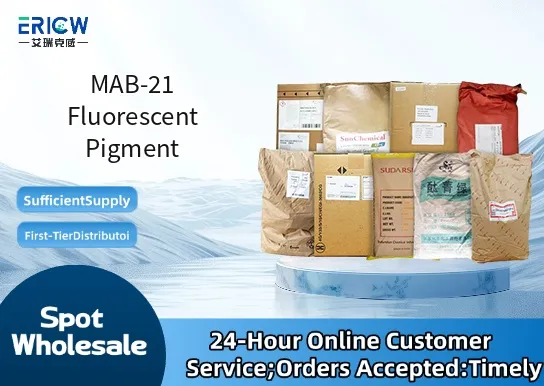
High-intensity fluorescence under UV-A (365 nm) and visible blue light excitation
Excellent thermal stability up to 220°C for extrusion and high-temperature processing
Good dispersion performance in both polar and non-polar polymer matrices
Low migration tendency in PVC, PS, ABS, and polyolefin-based systems
Non-heavy-metal formulation compliant with RoHS and REACH SVHC requirements
Security printing inks for banknotes, passports, and tax stamps
Fluorescent masterbatches for safety signage and emergency egress markings
UV-responsive coatings for industrial part identification and traceability
Special-effect inks for packaging, labels, and promotional materials
Fluorescent additives in optical filters and sensor calibration standards
| Chemical Type | Organic fluorescent compound (benzoxazole derivative) |
| Product Form | Fine free-flowing powder |
| Appearance | Yellow-orange dry powder, uniform particle size distribution |
| Primary Applications | Polymer masterbatches, solvent-based & UV-curable inks, protective coatings |
| Key Features | UV-stable, non-bleeding, low volatility |
| Benefits | Consistent chroma output, minimal batch-to-batch variation, easy handling |
| Storage Conditions | Store in cool, dry place below 30°C; protect from direct sunlight and moisture |
| Regulatory Compliance | REACH registered; RoHS 2.0 compliant; no SVHCs above threshold |
Q1: What types of resin systems is MAB-21 compatible with?
A: MAB-21 exhibits good compatibility with a wide range of thermoplastic and thermosetting systems, including ABS, PS, PC, PMMA, PVC, and unsaturated polyesters. Compatibility in polyolefins may require evaluation with appropriate dispersants or carrier resins.
Q2: How stable is the fluorescence under UV exposure and thermal processing?
A: MAB-21 offers robust photostability under typical indoor UV conditions and maintains fluorescence integrity during standard melt-processing temperatures up to approximately 240 °C for short residence times. Prolonged exposure above this threshold or intense outdoor UV may gradually reduce intensity over time.
Q3: What is the recommended dosage range for optimal fluorescence effect?
A: The effective dosage generally ranges from 0.1% to 2% by weight, depending on the base polymer, desired chroma intensity, and part thickness. Lower concentrations are typically sufficient in transparent or light-colored matrices, while higher loadings may be needed for opaque or dark systems to achieve visible fluorescence.
Q4: Can MAB-21 be used in food-contact or medical-grade applications?
A: MAB-21 is not pre-qualified for direct food-contact or implantable medical use. Its suitability for regulated applications depends on full formulation assessment, end-product testing, and compliance verification against applicable regional requirements (e.g., FDA, EFSA, or ISO 10993). Customers must conduct their own regulatory due diligence.
Contact With Us:
E-mail: wangxingqiang@ericwchem.com
Have a Questions? Call Us:
Add:
Building A1, Jiete Industrial Park, Huangpu District, Guangzhou City, Guangdong Province, China